

A recent Gartner report states that 60% of executives believe their current business model will be obsolete by 2027. That’s not a distant threat—it’s next year. If you feel a vague sense of unease about the rapid emergence of AI agents, quantum computing breakthroughs, and the shift toward Web 4.0, you’re not overreacting. You’re sensing a strategic Technological Inflection Point—a moment where the old rules of competition break down, and new leaders emerge. The businesses that thrive in 2026 aren’t waiting for the disruption to hit; they are building their lifeboats now.
The problem isn’t a lack of awareness. The problem is paralysis. The technological landscape is too broad, the changes are too fast, and the daily grind is too demanding. How do you prepare for a future that feels both urgent and undefined? The answer isn’t in a five-year plan—that’s obsolete before it’s printed. The answer is in a focused, agile, and actionable 90-day plan.
This article is your tactical playbook. In the next 10-12 minutes, you will get a complete, week-by-week framework to navigate toward 2026 with confidence. You will learn how to conduct a targeted technology audit of your own operations, prioritize the 2-3 disruptions that actually matter to your business, and launch a controlled pilot project within a single quarter. We will cover the essential frameworks, budgeting realities, and common pitfalls. By the end, you will have a clear roadmap—not a vague strategy—to turn a period of massive disruption into your greatest competitive advantage. Let’s build your plan.
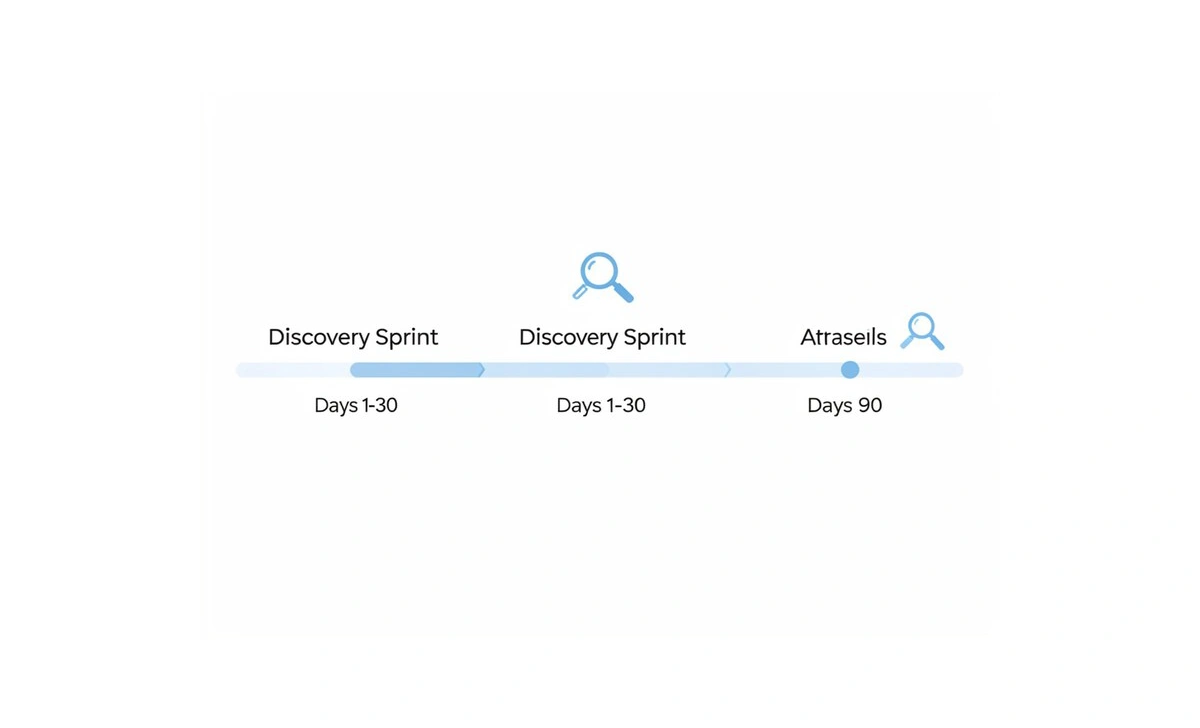
Phase 1: Weeks 1-30 – The Discovery Sprint (Assessment & Awareness)

The goal of the first month is not to act, but to see clearly. You must diagnose your organization’s current health and define the specific technological forces that will impact it. This phase is about moving from general anxiety to specific understanding.
Weeks 1-2: Conduct Your Digital Readiness Audit.
Start by evaluating your current state. This isn’t about your tech stack; it’s about your people, processes, and data readiness. Use a simple scoring system (1-5) for each:
- People: How digitally literate are teams? Is there a culture of learning?
- Process: How many core processes are manual or reliant on legacy systems?
- Data: Is your data clean, accessible, and integrated, or is it siloed?
- Technology: How old is your core tech stack? What is your cloud adoption level?
This audit gives you a baseline. You cannot measure progress if you don’t know your starting point.
Weeks 3-4: Map the 2026 Disruption Landscape Now, look outward. You don’t need to track every new gadget. Focus on the macro-disruptions with the highest potential to reshape your industry’s value chain. For most, this will be:
- Autonomous AI Agents: Moving beyond ChatGPT to AI that can execute multi-step tasks (e.g., handling a full customer service ticket, managing a marketing campaign).
- Spatial Computing & The Immersive Web: The convergence of AR/VR, digital twins, and 3D internet.
- Post-Quantum Cryptography: The urgent need to future-proof data security as quantum computers advance.
Your task is to research one concise, credible report on each (sources like Gartner, MIT Tech Review, or industry-specific analysts). Summarize in one paragraph how each trend could specifically threaten or benefit your business model.
Phase 2: Weeks 31-60 – Strategy & Prioritization (The Planning Sprint)
With clarity on your internal state and the external landscape, you now make the critical choices. This phase is about ruthless prioritization and strategic alignment.
Week 5: Run a “Stop, Start, Continue” Workshop. Gather key stakeholders. Using your findings, categorize initiatives:
- STOP: List processes, tools, or projects that drain resources and offer no future value. This frees up budget and attention.
- START: Identify the 2-3 high-potential opportunities from your disruption map. Be specific: “Start a pilot using AI agents to automate our invoice processing.”
- CONTINUE: Acknowledge current projects that are already building future readiness.
This exercise creates the strategic space and focus needed for something new.
Week 6: Build Your Business Case & Secure Resources For your top “START” initiative, build a one-page business case. It must answer:
- Objective: What will this pilot prove or learn?
- Scope: What is in and out of scope? (Keep it small!)
- Timeline: 30-60 days for the pilot phase.
- Resources Needed: Specific people (dedicate at least 20% of 2-3 key members’ time), technology (often a SaaS tool with a free trial), and budget (see below).
- Success Metrics: Define 2-3 key performance indicators (KPIs). For an AI pilot, this could be “Reduce time spent on task X by 40%” or “Achieve 95% accuracy in automated data entry.”
Weeks 7-8: Assemble Your Tiger Team and Finalize the Plan. Form a small, cross-functional team (Tiger Team) with a clear leader. Their mandate is to execute the pilot. Finalize your 90-day technology roadmap document, sharing it widely to create organizational alignment and accountability.
Budgeting for Disruption: A Realistic Cost Breakdown
 Your 90-day plan’s cost is an investment in risk mitigation and future growth. Here’s a realistic breakdown for a small to medium-sized business:
- Low-Budget Approach ($1k – $5k): Focuses on learning. Costs cover SaaS tool subscriptions for pilots (e.g., AI workflow automation platforms), online training for your team, and consultant hours for a strategy workshop.
- Mid-Range Plan ($5k – $25k): Funds actionable pilot projects. This includes dedicated personnel time (20-30% of 2-3 employees), more robust software, and potentially hiring a freelance specialist to guide implementation.
- High-Investment Strategy ($25k+): For larger organizations ready to move fast. Encompasses full-time project management, custom development or integration work, and comprehensive training programs.
⚠️ Warning: The highest hidden cost is organizational drag—the time lost to meetings, change resistance, and unclear communication. Mitigate this by having an iron-clad scope and a dedicated, empowered team.
5 Common Mistakes That Derail Tech Transition Plans
- Boiling the Ocean: Trying to prepare for every possible disruption. You will exhaust resources and achieve nothing. Fix: Pick one, focused pilot.
- Delegating to IT Alone: This is a business strategy challenge, not an IT ticket. Fix: Keep business leadership (CEO, department heads) actively involved and accountable.
- Chasing the Shiny Object: Implementing tech for tech’s sake. Fix: Every initiative must link back to a core business objective (reduce cost, acquire customers, enter new markets).
- Skipping the “Why”: Failing to communicate the urgent rationale to your team. Fix: Transparently share your readiness audit and disruption map company-wide.
- Neglecting Culture: Forgetting that technology is adopted by people. Fix: From Day 1, pair technical plans with a change management and upskilling cadence.
Expert Tips for a Future-Proof Execution
- Adopt a “Learn Fast” Mentality: Frame your pilot as a learning experiment, not a perfect product launch. This reduces pressure and encourages innovation.
- Create a “Watchlist”: Maintain a simple, shared document tracking the 5-10 key technologies you’ve identified. Assign someone to update it monthly with a one-line summary of major developments.
- Build External Brain Trust: Dedicate 1-2 hours per month to networking with a technologist outside your industry. Their perspective will reveal blind spots.
- Implement a “Sunset Rule”: For every new tool or process you adopt, commit to decommissioning an old one. This prevents costly, confusing tech sprawl.
- Measure Leading Indicators: Beyond financial KPIs, track metrics like employee skill acquisition rates and process digitization percentage. These signals affect long-term health.
How to Get Started: Your First Week Checklist
Don’t wait for perfect conditions. Start this Monday:
- Block 2 hours on your calendar for the “Digital Readiness Audit.”
- Email 3 key leaders to schedule the 90-minute “Stop, Start, Continue” workshop for Week 5.
- Bookmark one industry analyst report (e.g., Gartner’s Top Tech Trends) to read in Week 3.
- Download a free project management template (like in Notion or ClickUp) to serve as your 90-day roadmap.
- Announce to your team that you are initiating a focused 90-day program to prepare for future tech shifts. Invite their input.
FAQs
What is a technological inflection point?
A technological inflection point is a moment of profound change, where the adoption of a new technology fundamentally and permanently alters the competitive landscape of an industry. It creates new leaders and makes old ways of doing business obsolete. Think of the shift from desktop to mobile internet.
How is this 90-day plan different from a digital transformation?
Digital transformation is a broad, ongoing journey. This 90-day plan is a targeted sprint designed specifically to prepare for the imminent disruptions of 2026. It’s more urgent, more focused on external threat analysis, and designed to create immediate, tangible readiness and learning.
What if I’m a small business with a tiny budget?
The plan scales perfectly. For a small business, your “pilot” might be using a $29/month AI tool to automate customer email sorting. Your “Tiger Team” might be you and one employee. The principles—audit, prioritize, experiment—are the same. The low-budget approach is often more agile and decisive.
Which technology should I pilot first?
Choose the one that solves your most acute, expensive, or time-consuming problem. If data entry is drowning your staff, pilot an AI agent for document processing. If customer onboarding is complex, explore an interactive digital guide. Let your biggest pain point guide your first investment.
How do I handle employee resistance to new tech?
Involve them from the start. Share the “why” from your disruption research. Frame new tools as assistants that remove grunt work, not replacements. Provide dedicated, paid time for training and reward early adopters who share their learnings.
What’s the single most important success factor? Executive Commitment.
If leadership is not actively championing the plan, allocating resources, and participating in key workshops, the initiative will fail. This must be a top strategic priority, not a side project.
Conclusion
The technological inflection point of 2026 is not a fate to be endured; it is a transition to be managed. The difference between the companies that are disrupted and those that lead the disruption will come down to focused, deliberate preparation—the kind you can start today.
