To finish a DIY weekend project: define the project in one sentence with three “done” criteria, break it into 15–30 minute tasks, buy all materials on Friday, schedule a hard stop at 5 PM Saturday, set up your workspace before starting, work task-by-task in sequence, and do a final walkthrough before packing up tools.
Most unfinished DIY projects aren’t a skill problem — they’re a planning problem. If you’ve ever started painting a room and stopped halfway because you ran out of primer, or spent your entire Saturday buying supplies instead of using them, this guide is for you. Whether you’re patching drywall for the first time or tackling your third shelving unit, the steps below will get you from idea to done in a single weekend.
The biggest misconception? That you need more time. You don’t — you need a better system.
Why DIY Weekend Projects Are Worth Getting Right
Finishing what you start isn’t just satisfying — it has a real, measurable payoff.
- Save money: The average small home improvement project costs $150–$400 in materials. Hiring a contractor for the same job typically runs $600–$1,200.
- Build real skills: Each completed project builds your judgment on materials and tools. The second project of the same type takes noticeably less prep time than the first.
- Reduce mental clutter: The concept behind this is well-documented in psychology — unfinished tasks stay mentally active, creating a background drain on focus that completed tasks don’t.
- Who benefits most: Homeowners who have basic tool familiarity but keep losing momentum mid-project.
Ignore this system, and you’ll keep buying supplies, starting strong on Saturday morning, and abandoning the project by Sunday afternoon — leaving a half-painted wall or three holes in your drywall.

How to Complete DIY Weekend Projects: Step-by-Step
Step 1: Define the Project in One Sentence
Before you touch a tool, write down the project in one sentence: what it is, where it goes, and what “done” looks like. “Hang three floating shelves in the hallway at 5 feet height” is a project. “Fix up the hallway” is not.
- What to do: Write your one-sentence definition. Then list three criteria that mean the project is finished — for example: shelves level, hardware hidden, holes patched.
- Common mistake: Starting with a vague goal. Vague goals expand. Specific goals get done.
- How to know you did it right: You can describe the finished result to someone else in 10 seconds.
Time needed: 10 minutes. Tools needed: Notebook or phone notes app
Take a “before” photo. It motivates you to finish and gives you a clear comparison once the job is done.
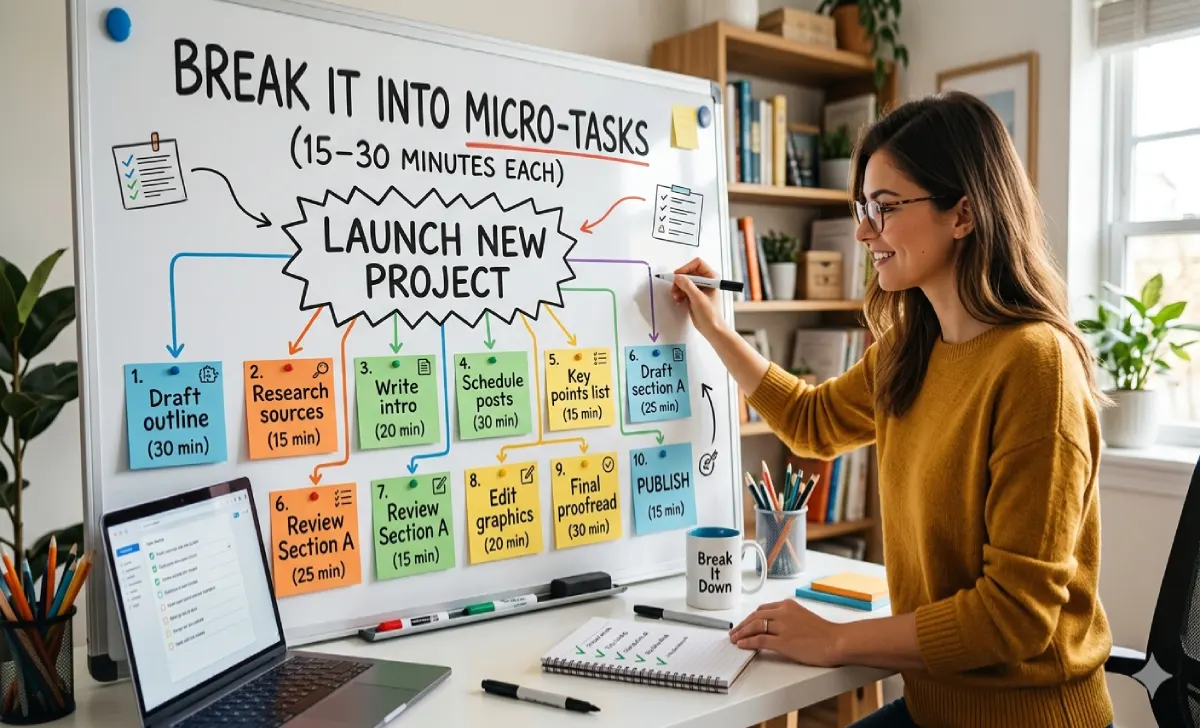
Step 2: Break It Into Micro-Tasks (15–30 Minutes Each)
Big projects feel overwhelming. Tasks don’t. Break every project into steps that take 15–30 minutes each.
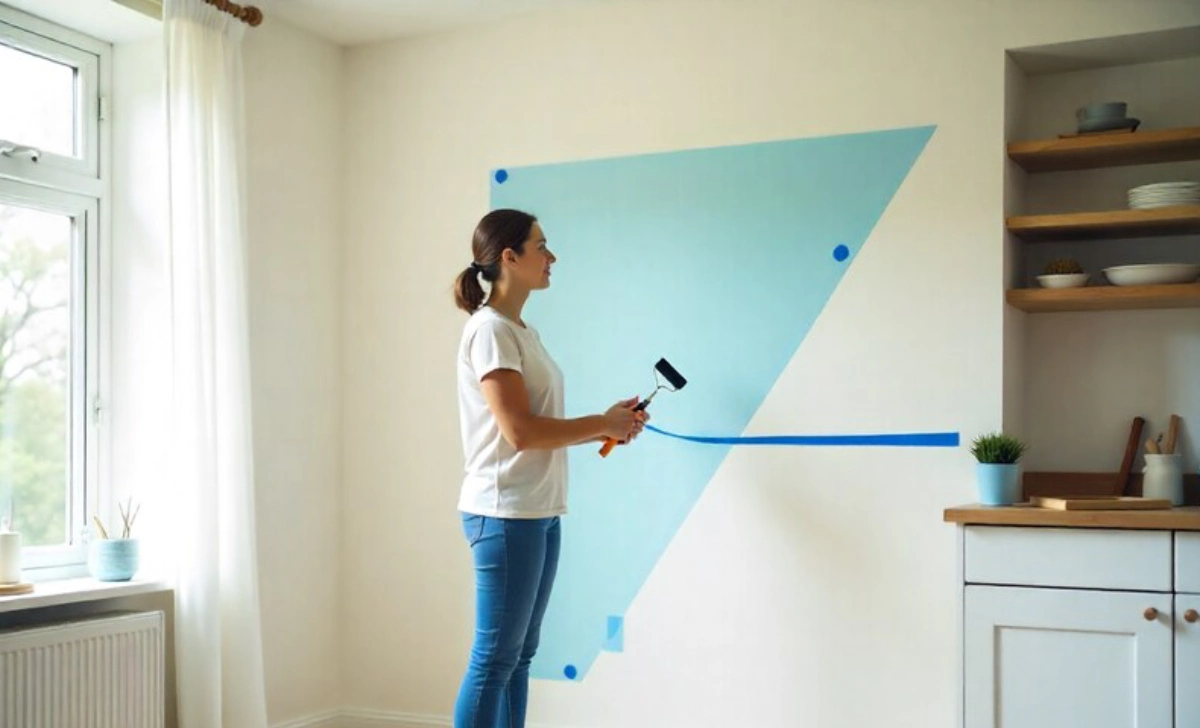
“Paint the room” becomes: tape edges (20 min), prime walls (30 min), first coat (30 min), dry time (schedule this), second coat (30 min), remove tape (15 min).
List every micro-task in order. Note which tasks require dry time, curing time, or a second person.
The most common mistake here is forgetting dry time entirely. Latex paint needs 2–4 hours between coats. Plan this into your schedule, not around it. Schedule dry-time tasks in the morning so they cure while you eat lunch or run errands — don’t lose that time.
Time needed: 15–20 minutes.s Tools needed: Pen and paper, or a free app like Todoist
Step 3: Buy All Materials on Friday (Not Saturday Morning)
Saturday morning hardware store trips kill weekend projects. You lose 1–2 hours, return tired and hungry, and lose momentum before you start. Shop on Friday evening with a precise list instead.
Write your materials list from your task list, one task at a time. Include exact quantities:
“1 quart primer (white), 1 gallon paint (Benjamin Moore Chantilly Lace OC-17), 2-inch painter’s tape (3M ScotchBlue)”
Don’t estimate materials by memory. Calculate exactly — 1 gallon of paint covers 350–400 square feet per coat. Write down the exact paint color code, not just the name. A different batch from the same name can have visible variation.
Buy 10–15% more material than you calculate. Returns are easy. Mid-project hardware runs are not.
Time needed: 20–30 minutes to list and share.op Tools needed: Measuring tape, calculator, pH, one or note.book
Step 4: Schedule a Start Time and a Hard Stop
Open-ended projects drift. Build your weekend around two time blocks: Saturday (main work) and Sunday (finishing, cleanup, and fixes). Start Saturday, no later than 9 AM. Set a hard stop at 5 PM — this prevents exhausted evening decisions that cause mistakes.
- What to do: Block your schedule in writing. Assign each micro-task a time slot. Build in a 30-minute buffer for every 3 hours of work.
- Common mistake: Skipping the Sunday buffer slot. Things go wrong — a stripped screw, a wall anchor that won’t hold. Sunday is your safety net.
- How to know you did it right: By 9 AM Saturday, you know exactly what you’re doing at 11 AM, 1 PM, and 3 PM.
Time needed: 10 minutes. Tools needed: Google Calendar, a paper planner, or your phone’s notes
Text a friend your start time. Social accountability — even informal — meaningfully increases follow-through.
Step 5: Set Up Your Workspace Before You Start
A messy or unprepared workspace slows you down significantly. Lay out every tool and material before you start the first task. Move furniture. Lay drop cloths. Charge your drill.
- What to do: Do a 10-minute workspace prep before task one. Lay out tools in order of use. Keep a trash bag nearby for packaging and off-cuts.
- Common mistake: Working around furniture instead of moving it. This leads to uneven results and missed corners.
- How to know you did it right: You can start your first task without searching for anything.
Time needed: 10minutes.s Tools needed: Drop cloths, trash bags, extension cord, and charged tools
Use a portable tool bag or bin to keep everything in one place. Searching for a screwdriver mid-task is a focus killer.
Step 6: Execute Task-by-Task — Not Area-by-Area
This is the step most people skip explaining, so here it is clearly: work through your task list in sequence, completing each item fully before moving to the next. Don’t jump between areas of the room or start a second task before the first is done.
The reason this matters: partial work across multiple areas creates a false sense of progress. You’ll feel busy, but nothing will be finished. Completing one task fully before starting the next gives you real checkpoints and keeps the e scope from expanding.
Start at 9 AM. Execute your scheduled micro-tasks in order. Stop at 5 PM regardless of progress. This boundary prevents the fatigue that causes mistakes. You finish Saturday feeling tired but capable — not exhausted and sloppy.
If you notice other problems while working (a patch of wall damage, a cabinet door that sticks), write them on a “future projects” list. Don’t act on them today.
Sunday morning, assess what’s left. Most projects need 2–4 hours of Sunday finishing: touch-ups, small fixes, and final cleanup. Budget 20 minutes for a final walkthrough and touch-ups before packing up tools.
Step 7: Do a Final Walkthrough and Sign Off
When you think you’re done, you’re 90% done. The last 10% — touching up paint edges, tightening hardware, wiping down surfaces — is what separates a good result from a great one.
- What to do: Walk through the finished project against your three “done” criteria from Step 1. Take an “after” photo. Patch any small issues immediately, while your tools are still out.
- Common mistake: Packing up tools before the final check. Once the tools are away, small fixes never get done.
- How to know you did it right: The after photo matches or beats what you imagined in Step 1.
Time needed: 15–20 minutes Tools needed: Phone camera, touch-up materials, cleaning supplies
Clean up completely before you call it done. A clean room makes your work look better — and you’ll feel the satisfaction of a truly finished project.
DIY Weekend Project Steps at a Glance
| Step | Action | Time | Key Tool/Resource | Difficulty |
|---|---|---|---|---|
| 1 | Define the project in one sentence | 10 min | Notebook/phone | Easy |
| 2 | Break into 15–30 min micro-tasks | 15–20 min | Todoist / pen & paper | Easy |
| 3 | Buy all materials on Friday | 30–60 min | Measuring tape, list | Easy |
| 4 | Schedule start time + hard stop | 10 min | Google Calendar | Easy |
| 5 | Set up the workspace before starting | 10 min | Drop cloths, tool bag | Easy |
| 6 | Work task-by-task, not area-by-area | Varies | Task checklist | Medium |
| 7 | Final walkthrough and sign-off | 15–20 min | Camera, touch-up kit | Easy |
A Quick Note on Safety
Before starting any project involving walls, electrical fixtures, or plumbing:
- Check for pipes and wires before drilling into walls. Use a stud finder with AC detection, or turn off power to the circuit before drilling near outlets or switches.
- Turn off the circuit breaker before any work involving light switches, outlets, or fixtures — even if you think the switch is off.
- Know when to stop. Load-bearing walls, main plumbing supply lines, and anything involving the electrical panel should be handled by a licensed professional.
These aren’t warnings to skip. They’re 30-second checks that prevent expensive, dangerous mistakes.
7 Mistakes That Kill DIY Weekend Projects
Mistake 1: Vague project definition
- Why it happens: Excitement skips the planning phase.
- Cost: 2–3 hours wasted, scope expands uncontrollably.
- Fix: Write your project in one sentence with three completion criteria before touching any tool.
Mistake 2: Shopping on Saturday morning
- Why it happens: People underestimate how long hardware store trips take.
- Cost: 1–2 hours lost, momentum broken before you start.
- Fix: Always shop on Friday. Have everything ready the night before.
Mistake 3: Forgetting dry time
- Why it happens: Dry time isn’t visible on a to-do list.
- Cost: Ruined finish, peeling paint, wasted materials.
- Fix: Write dry times into your task list. Latex primer: 1 hora. Latex paint: 2–4 hours. Caulk: 24 hours.
Mistake 4: Scope creep mid-project
- Why it happens: You notice other problems while working.
- Cost: Main project unfinished, multiple half-done tasks.
- Fix: Keep a “future projects” list nearby. Write down what you notice. Don’t act on it today.
Mistake 5: No hard stop time
- Why it happens: “I’ll just finish this one thing” turns into 9 PM exhaustion.
- Cost: Tired decisions, poor quality work in the final hour, next-day soreness.
- Fix: Set a 5 PM hard stop. What’s not done goes to Sunday’s session.
Mistake 6: Wrong or insufficient materials
- Why it happens: Eyeballing quantities instead of calculating.
- Cost: Mid-project supply run, color mismatch if paint batches differ.
- Fix: Calculate exact quantities, then add 10–15% buffer. Write down the exact paint color code — not just the name.
Mistake 7: Skipping the final walkthrough
- Why it happens: You’re tired and want to be done.
- Cost: Small, fixable flaws become permanent features of the room.
- Fix: Budget 20 minutes for a walkthrough and touch-ups before you pack up tools.
How to Adapt This System to Your Situation
By Experience Level
- Complete beginner: Start with a single-wall paint project or shelf installation. Follow Steps 1–7 strictly. Don’t skip the material calculation.
- Some experience: Tackle multi-surface projects like a bathroom refresh (paint + new hardware + mirror). Use Steps 2 and 6 most carefully.
- Intermediate: You can handle projects like tile backsplash or built-in shelving. Your main risk is scope creep (Step 6) — stay disciplined.
- Avoid at any level: Starting without a written task list. This system works because it’s written down.
By Budget
- Under $100: Paint projects, hardware swaps, caulking, and minor patching. All 7 steps apply.
- $100–$300: Shelving, cabinet repaints, fixture replacements. Buy a buffer quantity — returns are easy, mid-project trips are not.
- $300–$600: Tile work, trim installation, furniture builds. Add a 2-hour research block on Thursday evening before your Friday shopping trip.
By Goal
| Goal | Project type | Time | Typical budget |
|---|---|---|---|
| Freshen up a room | Paint project | 1 weekend | $80–$180 |
| Improve storage | Floating shelves or a closet organizer | 1 weekend | $60–$200 |
| Fix ongoing annoyances | Leaky faucet, squeaky door, cracked tile | 2–4 hours | Under $50 |
| Boost resale appeal | Kitchen hardware swap, bathroom refresh | 1–2 weekends | $150–$400 |
By Time Available
- Under 4 hours: Single-task projects — patching holes, replacing a light switch, regrouting a small area.
- One full day (6–8 hours): Single-room painting, shelf installation, vanity replacement.
- Full weekend (12–14 hours): Multi-surface room refresh, built-in shelving, tile backsplash.
Tools and Resources That Actually Help
Planning Tools
| Tool | What it does | Best for | Cost |
|---|---|---|---|
| Todoist | Task lists with deadlines | Micro-task scheduling | Free / paid plans available |
| Notion | Project planning + notes | Complex multi-step projects | Free / paid plans available |
| Paper notebook | Simple task + materials lists | Any project | Free |
| Google Calendar | Time-blocking weekends | Scheduling work sessions | Free |
Essential Physical Tools (Beginner Kit)
- Cordless drill/driver — 18V, mid-torque (DeWalt DCD777 or Ryobi P215)
- Stud finder — magnetic or electronic (Franklin Sensors ProSensor 710 is beginner-friendly)
- 2-inch and 4-inch putty knife — for patching and spreading joint compound
- 4-foot level — aluminum, not plastic; essential for shelves and frames
- 3M ScotchBlue painter’s tape (2-inch) — for clean paint edges
- Drop cloths — canvas, not plastic; they don’t slip and absorb paint better
- Sanding sponges (120-grit and 220-grit) — for patching and surface prep
Measurement & Calculation Resources
- Paint calculator: benjaminmoore.com/paint-calculator — enter room dimensions for exact gallons
- Tile calculator: tilebar.com/calculator — accounts for grout lines and 10% overage
- Wood cutting list: cutlistplanner.com — improves lumber cuts to minimize waste
Building the Long-Term Habit
The real win from this system isn’t one finished project — it’s the habit of finishing.
Build a running “home project list” — a note in your phone where you capture every fix or upgrade you notice. Review it monthly. Prioritize by impact and budget. Work through 1–2 projects per month.
After the first project, the second of the same type takes noticeably less prep time. After 12 months of this, your home will look different — and you’ll have avoided a significant amount in contractor fees on the jobs you could handle yourself.
Your Next Step
Three things decide whether a DIY weekend project gets finished: a specific written task list, all materials ready before Saturday morning, and a hard stop time that prevents tired mistakes. Everything else — skill, tools, experience — is secondary to those three habits.
Pick one project you’ve been putting off. Write it in one sentence right now. Then use Steps 1–7 this weekend to finish it.