This article was originally written as a forward-looking investment case for Li Auto. We have fully updated it with actual results. The short version: the bull thesis for 2025 did not play out. Full-year deliveries fell 19%, revenue dropped 22.3%, and the company’s first pure battery-electric vehicle — the MEGA — significantly underperformed commercially. Li Auto is now entering 2026 in a different position than anticipated, with a new product cycle, a $1 billion buyback, and a stock near three-year lows.
Li Auto (NASDAQ: LI; HKEX: 2015) is a Chinese electric vehicle maker that built an unusually profitable business on extended-range electric SUVs — vehicles that combine a battery drivetrain with a small onboard gasoline generator to eliminate range anxiety. For a few years, that formula worked extremely well. But 2025 tested the story in ways that matter to anyone holding or considering the stock today.
Full-year 2025 revenues fell 22.3% to RMB 112.3 billion. Vehicle deliveries dropped from 500,508 in 2024 to 406,343. Free cash flow turned deeply negative. CEO Xiang Li’s bet on a pure battery-electric product — the MEGA — did not generate the demand the company needed. And as of early 2026, the stock sits roughly 35% below where it was a year ago.
The honest investor question for 2026 is not whether Li Auto can double. That ship has sailed. The real question is whether the upcoming Li L9 launch and a $1 billion share buyback mark the start of a genuine recovery — or whether a difficult 2025 is just the beginning of a longer structural decline. This article answers that question with current data, not 2024-era projections.
What Li Auto Actually Is — and Why the EREV Model Still Matters
Understanding the investment starts with understanding the product. Li Auto does not build conventional EVs. Its L-series lineup — the L7, L8, and L9 — runs on Extended-Range Electric Vehicle technology, or EREV. The drivetrain is fully electric, but a compact gasoline engine sits on board purely to recharge the battery when it runs low. Drivers get the efficiency of an EV for daily use and the range security of a gas-powered vehicle for long trips.
For Chinese families — Li’s core customer — this solves a real problem. Charging infrastructure outside major Chinese cities remains inconsistent, and range anxiety is a legitimate concern for buyers considering a full BEV. Li Auto’s answer was not to wait for infrastructure to catch up but to sell around the problem entirely.
That positioning is still defensible in 2026. However, it is no longer exclusive. Huawei’s AITO brand and Xiaomi — which entered the car market with the SU7 and is now expanding into SUVs — are both offering EREV variants or competitive alternatives in the premium family segment. Li Auto’s differentiation has narrowed, which is part of why 2025 was hard and why the L9 launch carries so much weight.
What the 2025 Investment Thesis Got Right — and Where It Broke
Honest post-mortems are rare in financial writing. Here is one.
What held up
- The geopolitical discount was real. The persistent ceiling on Li Auto’s P/E multiple caused by its NASDAQ ADR structure proved accurate. U.S.-China tension did not resolve and continued to depress the multiple.
- The BEV transition was the biggest risk. The thesis correctly identified the move into pure battery-electric vehicles as the single largest operational challenge. It was.
- Vehicle margin was the right metric to watch. When margins compressed, it accurately signaled the thesis was deteriorating before the stock fully reflected it.
What broke
- The MEGA failed commercially. Li Auto’s first pure BEV launched to weak demand and mixed reviews, dragging deliveries and undermining the BEV expansion story entirely.
- Delivery growth turned sharply negative. The 50% annual growth assumption proved unreachable. Full-year 2025 deliveries fell 19% year over year rather than growing.
- Profitability eroded more than expected. Full-year net income fell 85.8% to RMB 1.14 billion. Free cash flow turned negative at -$1.83 billion for the year.
- Competition came from the wrong direction. The thesis focused on Tesla and NIO. The real competitive pressure came from Huawei and Xiaomi — tech companies whose software-first brand appeal resonated strongly with the premium SUV buyer Li Auto was targeting.
Li Auto Q4 and Full Year 2025 Results: The Numbers That Matter
Before any forward-looking analysis, here is the factual baseline from the Q4 2025 earnings report published March 12, 2026.
| Metric | Q4 2025 | Q4 2024 | Change |
|---|---|---|---|
| Total Revenue | RMB 28.8B ($4.1B) | RMB 44.3B | −35.0% |
| Vehicle Deliveries | 109,194 | 158,696 | −31.2% |
| Vehicle Margin | 16.8% | 19.7% | −2.9pp |
| Net Income | RMB 20.2M ($2.9M) | RMB 3.5B | −99.4% |
| Metric | Full Year 2025 | Full Year 2024 | Change |
|---|---|---|---|
| Total Revenue | RMB 112.3B | RMB 144.5B | −22.3% |
| Vehicle Deliveries | 406,343 | 500,508 | −18.8% |
| Vehicle Margin | 17.9% | 19.8% | −1.9pp |
| Net Income | RMB 1.14B | RMB 8.0B | −85.8% |
| Free Cash Flow | −$1.83B | Positive | Sharp reversal |
| Year-End Cash Position | RMB 101.2B ($14.7B) | — | Remains strong |
Two details deserve attention. First, Q4 showed sequential improvement: revenues rose 5.2% from Q3, and net income turned positive again after a Q3 loss. Management pointed to this as evidence of stabilization. Second, the cash position — RMB 101.2 billion at year-end — is the company’s most important financial asset heading into 2026. It means Li Auto can fund the L9 launch, its charging network, and the buyback without raising capital or taking on meaningful debt.
Q1 2026 Guidance
Management guided for Q1 2026 vehicle deliveries of 85,000 to 90,000, representing another year-over-year revenue decline of roughly 16% to 21%. This guidance came in below analyst expectations and reflects the gap between the end of the current L-series model cycle and the L9 launch. In plain terms: the next 6–8 weeks are likely to be weak before the new product hits showrooms.
The 2026 Bull Case: Li L9 and the $1 Billion Buyback
The investment case for Li Auto in 2026 is simpler than it was in 2024 — and more binary. It comes down to one product and one capital allocation signal.
The Li L9: Li Auto’s Most Important Launch
The all-new Li L9 is scheduled to launch in Q2 2026. CEO Xiang Li described it on the Q4 earnings call as featuring “comprehensive upgrades in powertrain, autonomous driving, and chassis technology, all designed to deliver a generational leap in user experience.” Morgan Stanley, which maintained its rating on the stock after the buyback announcement, identified the L9 alongside the L6–L8 refresh starting in April as the catalysts most likely to restore operational momentum and rebuild market confidence.
The L9 is a six-seat flagship family SUV priced in the RMB 400,000–500,000 range — the same premium family segment where Li Auto built its reputation. If the L9 generates strong reservation numbers and initial margins hold above 17%, deliveries in Q3 and Q4 2026 could recover meaningfully toward 120,000–130,000 units per quarter.
The $1 Billion Buyback: What It Actually Signals
On March 24, 2026, Li Auto announced its first share repurchase program since its U.S. listing in July 2020. The board authorized buybacks of up to $1 billion through March 31, 2027, funded from existing cash reserves.
CEO Xiang Li stated: “The share repurchase program reflects our strong confidence in Li Auto’s strategic roadmap and future value creation.”
Two things are worth holding in tension here. On one hand, deploying $1 billion at prices near multi-year lows — the stock recently touched a three-year low near $16 — is precisely the kind of capital discipline investors want to see from management that genuinely believes in the recovery. On the other hand, Li Auto burned $1.83 billion in free cash flow in 2025. Buying back stock while deliveries are contracting and FCF is negative raises a fair question about priorities. The buyback is a floor signal, not a thesis in itself.
The 2026 Bear Case: What Could Keep This Story Broken
The downside risks in 2026 are different from those that defined 2024’s bear case.
- The L9 could underperform like the MEGA did. Li Auto’s track record with pure-BEV launches is now one miss. If the L9 EREV does not generate the reservation momentum that would justify a recovery thesis, the stock has limited support below current analyst price targets.
- Management instability is a new risk. Multiple key executives departed Li Auto in the first months of 2026. This is a yellow flag that the original thesis did not include.
- Huawei and Xiaomi are not standing still. Both companies are rapidly expanding their premium SUV offerings with software-first positioning that resonates with the premium Chinese family buyer. Li Auto cannot rely on product differentiation alone.
- Negative FCF limits room for error. With $1.83 billion in cash burned in 2025 and a $1 billion buyback now authorized, Li Auto’s buffer shrinks. Another down year on deliveries would put real pressure on the balance sheet, even from a starting cash position of RMB 101.2 billion.
- Geopolitical risk persists. As a Chinese ADR listed on NASDAQ, Li Auto remains exposed to audit regulation volatility, trade restriction escalation, and sentiment swings tied to U.S.-China relations. This is not a new risk but it has not gone away either, and the political environment has not become more stable.
Financial Metrics That Actually Matter in 2026
The framework for evaluating Li Auto has not changed. The baseline numbers to measure against have.
- Vehicle margin. The current floor is 16.8% (Q4 2025). Sequential improvement above 17.5% on the L9 launch would be a positive signal. A drop below 15% sustained over two quarters would warrant a full reassessment.
- Monthly and quarterly deliveries. The recovery target is a return to 100,000+ deliveries per quarter in H2 2026, driven by the L9 and L6–L8 refreshes. Q1 2026 guidance of 85,000–90,000 is the low point to compare against.
- Free cash flow trajectory. Negative FCF for the full year 2025 was a significant deterioration. Returning toward breakeven FCF in 2026 requires both higher deliveries and sustained margins. Watch this quarterly.
- R&D spending. Li Auto invested approximately RMB 21 billion in R&D in 2025, up meaningfully year over year. Management has described AI and autonomous driving as the core long-term investment. If R&D spend stabilizes or grows while product launches succeed, it supports the premium valuation case.
A Revised Scenario Model for 2026
The original 2x return math no longer applies. Here is a grounded scenario framework based on where the stock actually sits and what the L9 launch could realistically produce.
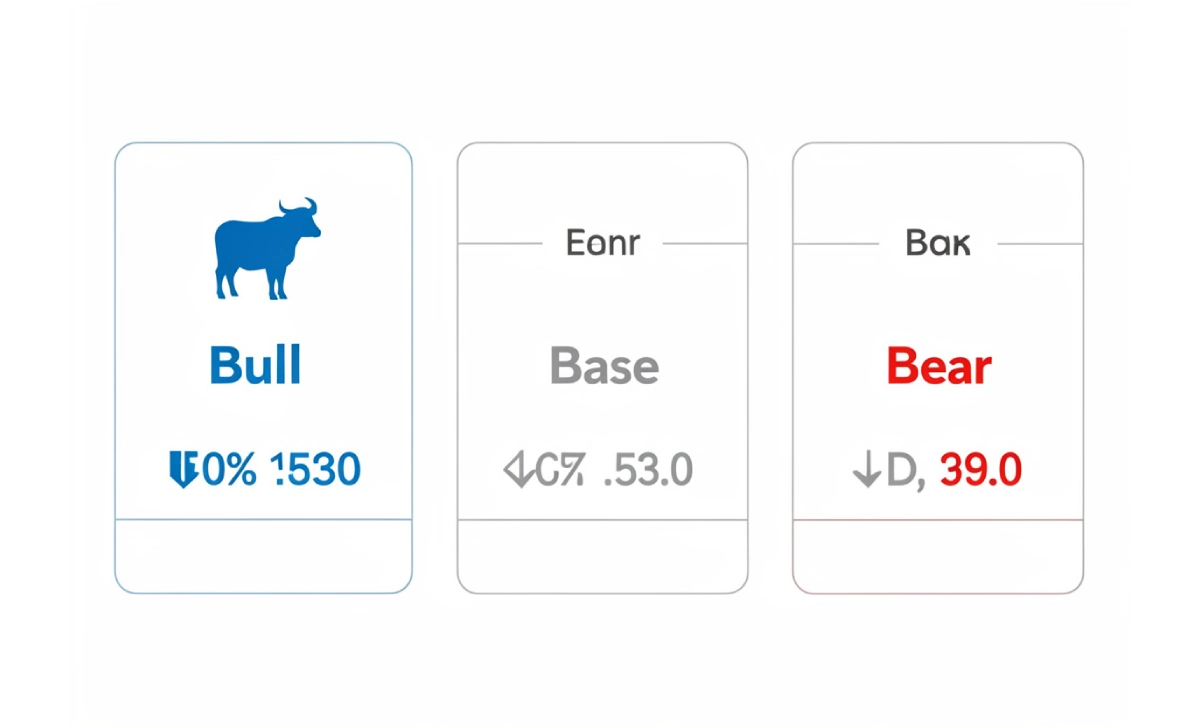
| Scenario | Conditions | H2 2026 Deliveries | Vehicle Margin | Implied Price Target |
|---|---|---|---|---|
| Bull | L9 generates strong reservations; L-series refresh drives sequential delivery acceleration; margins recover | 130,000–140,000/quarter | 18%+ | $24–$28 |
| Base | L9 delivers steady but unspectacular demand; deliveries stabilize but do not surge | 100,000–115,000/quarter | 16.5%–17.5% | $18–$22 |
| Bear | L9 disappoints; Huawei/Xiaomi take incremental share; management turnover accelerates | Below 90,000/quarter | Below 15% | Below $15 |
Analyst consensus currently sits around a $22 price target, aligning with the base case. The buyback provides some mechanical support near $17 as long as the company continues executing on repurchases.
Where Li Auto Sits in China’s EV Landscape Right Now
The competitive map has changed meaningfully since 2024. Here is where each major player stands today.
1. NIO
This is the most important update for anyone using older research. NIO is no longer the cash-burning laggard it was. NIO posted 124,807 deliveries in Q4 2025, up 71.7% year over year, and achieved its first-ever GAAP quarterly profit in the same period. Vehicle margins improved from 13.1% to 18.1% year over year. R&D fell 44.3% and SG&A dropped 27.5%. NIO stock is up roughly 29% over the past year, while LI is down roughly 35%. NIO carries only $1.61 billion in cash against $15.97 billion in liabilities, so the balance sheet is fragile. But operationally, NIO has closed the gap significantly.
2. Huawei AITO
Not mentioned in the original article, but now one of Li Auto’s most direct competitors. Huawei’s AITO brand — built on its HarmonyOS platform with full integration into the Huawei device ecosystem — has attracted premium SUV buyers who previously would have been Li Auto’s core customer. Huawei’s software positioning is a genuinely different value proposition from anything Li Auto currently offers.
3. Xiaomi
Xiaomi entered the passenger vehicle market with the SU7 sedan and is expanding its lineup toward the SUV segment. Its brand loyalty among Chinese tech consumers and its pricing strategy in the premium range create direct pressure on Li Auto. Xiaomi’s willingness to use vehicle sales as a longer-term ecosystem play means it can accept lower per-vehicle economics than Li Auto needs.
4. BYD
BYD competes primarily on volume and cost efficiency at lower price points. Its premium sub-brands (DENZA, Yangwang) push upmarket but do not yet threaten Li Auto’s specific ¥350,000–¥500,000 family SUV stronghold as directly as Huawei or Xiaomi.
5. XPeng
XPeng leads on ADAS technology and has made progress on execution consistency. Its MONA and X9 models aim at different segments from Li Auto, making direct competition less intense than with Huawei or NIO.
6. Tesla
Tesla remains a factor via price cuts and the Model Y. It still holds strong brand recognition among a subset of Chinese buyers but lacks the China-specific features and family configurations that Li Auto’s lineup is built around. Tesla is a competitor but no longer the primary pricing threat it was in 2023.
From Speculation to International Expansion
The original article described Middle East expansion as early-stage speculation. It is no longer speculation. In December 2025, Li Auto entered the markets of Egypt, Kazakhstan, and Azerbaijan. These are initial steps into international distribution, not a full-scale export push, but they represent the first concrete proof points of Li Auto’s stated international growth narrative.
At the same time, Li Auto’s domestic charging infrastructure reached 3,907 super charging stations equipped with 21,651 charging stalls as of December 31, 2025. This network is a meaningful asset for the L9 launch, particularly as Li Auto plans to position the new model’s charging capabilities as a feature differentiator.
How to Think About Position Sizing Today
The position sizing logic has not changed, though the trigger levels need updating.
If Li Auto fits your risk profile, dollar-cost averaging over several quarters remains the sensible approach in a volatile stock that is navigating a live product cycle transition. Treat it as a satellite holding — higher conviction within a specific thesis, not the anchor of a diversified portfolio.
Set triggers before capital is at risk. Consider adding to the position if: the L9 launch produces strong reservation numbers and Q2 2026 vehicle margins hold above 17%. Consider reducing or exiting if: two consecutive quarters show vehicle margins below 15%, or if further senior management departures signal deeper organizational instability.
Just as buying a vehicle over $50,000 requires careful financial judgment, allocating capital to a high-volatility growth stock in a transition period demands the same discipline. The buyback is management’s signal that they believe in the stock at current prices. That does not mean you have to agree — it means you have a concrete reference point from the people with the most information.
Final Words
2025 was a genuinely painful year for Li Auto investors, and the honest response to that is to acknowledge it plainly rather than paper over it with optimism. Deliveries fell. Margins compressed. The MEGA did not land. Free cash flow turned negative. The stock is near a three-year low.
What makes 2026 interesting — not necessarily compelling, but genuinely interesting — is that the conditions for a recovery are present. The Li L9 is a real product cycle, not a placeholder. The $1 billion buyback is funded by a real cash position. Sequential margin improvement in Q4 2025 is a small but real data point. And the stock, at roughly $17, reflects a substantial amount of disappointment already priced in.
Whether that is enough to warrant a position depends on your read of the L9 launch, your tolerance for the management uncertainty now visible in the executive departures, and your confidence that Huawei and Xiaomi do not systematically displace Li Auto in the premium family SUV segment over the next 18 months.
The framework is the same it has always been. Model the scenarios. Watch the quarterly delivery and margin data. Set your triggers before the emotions are involved. Then decide.
For additional context on the competitive dynamics shaping this market, see the related breakdown of how China’s EV rise is reshaping global auto markets and the deep-dive on Li Auto’s specific investment risk factors.