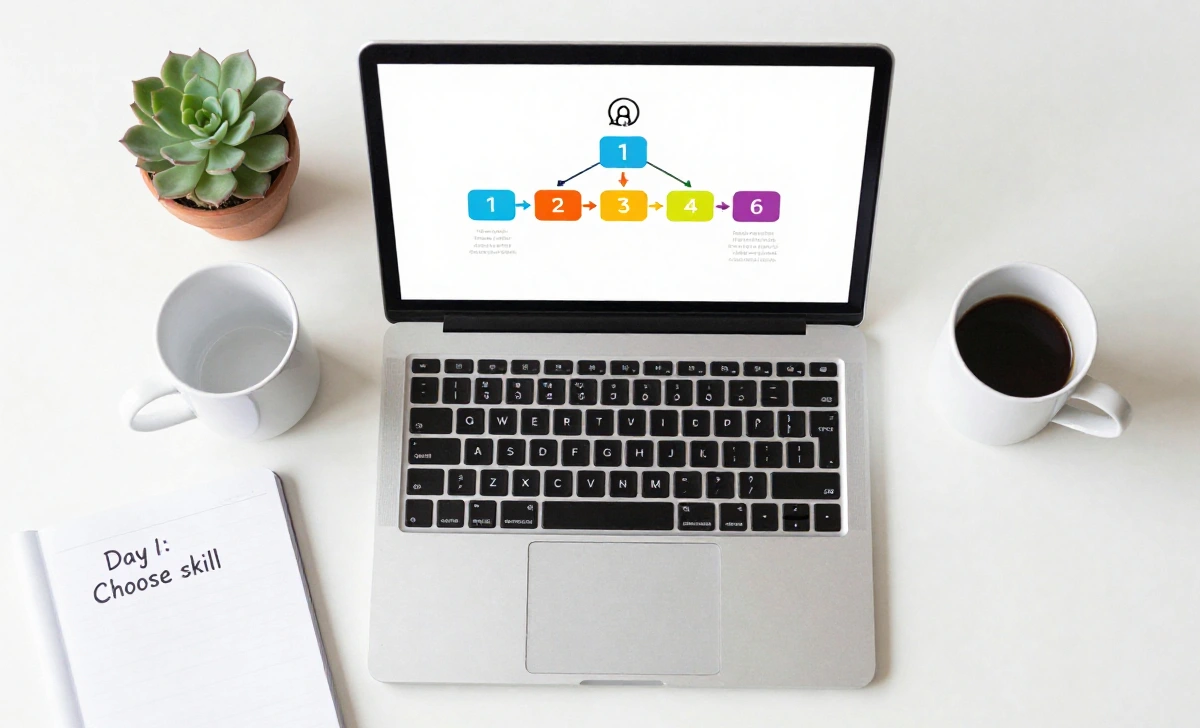
Feel overwhelmed every time you hear “digital marketing”? You’re not alone. 72% of small business owners feel they lack the time and knowledge to run effective online campaigns. The truth is, you don’t need a massive budget or a marketing degree to get started. You just need a clear plan that forces you to take action instead of drowning in theory. And if you ever decide to bring in outside help, there are affordable digital marketing agencies that work well for small budgets, but that’s a later decision.
This guide is for the absolute beginner: the freelancer, the new small business owner, the side-hustler who knows they need to be online but has no idea where to start. Your problem isn’t a lack of information. It’s too much information, leading to paralysis. The solution is a constraint-based sprint. We’re going to build and launch your first real digital marketing campaign in the 7-Day Digital Marketing Plan, with zero budget required.
By following this day-by-day plan, you will:
- Define a single, clear goal for your first campaign.
- Identify and find your ideal audience online.
- Create one compelling piece of content designed to attract them.
- Choose one channel to focus your energy on.
- Launch, track, and learn from your first real campaign data.
Expect to invest 60 to 90 minutes each day. The cost? $0. The result? You’ll move from clueless beginner to someone who has actually launched a campaign and learned from real-world data. Let’s begin.
Day 0: Define Your Goal and Your Audience
Before any tools or tactics, you need a destination and a map. Skipping this step is the number one reason beginner campaigns fail.
Your 7-Day Goal: This must be Specific, Measurable, and Actionable. Not “get more customers.” Instead: “Get 20 email sign-ups for my weekly tips newsletter” or “Book 3 free consultation calls.” This goal will guide every decision you make this week.
Your Ideal Customer Avatar: Who are you trying to reach? Be specific. Give them a name, an age, a job, and a core problem they face that you solve. For example: “Sarah, 35, a solopreneur graphic designer who struggles to find consistent clients.” This focus stops you from wasting time shouting into the void.
Day 1: Claim Your Digital Real Estate
Today is about ownership, not perfection. You’re securing the basic assets you control.
Website/Home Base: If you don’t have a website, use a free builder like Carrd or Canva to create a simple, one-page site. It needs: who you are, what you do, who you help, and a clear Call-to-Action (e.g., “Sign Up for My Free Guide”). Already have a site? Make sure your contact form works and your CTA is visible.
Core Social Profile: Pick one platform where your ideal customer likely spends time (LinkedIn for B2B, Instagram for visual brands, Facebook for local services). Fully complete your profile with a clear bio, a professional photo, and a link to your website.
Day 2: Listen and Learn With Simple Research
You’re not creating in a vacuum. Spend today gathering intelligence.
Audience Research: Use Google Trends to see what topics your audience is searching for. Visit relevant Reddit forums or Facebook groups and read what questions people are asking. Don’t post. Just listen.
Competitor Research: Find 3 to 5 successful competitors or similar businesses. What content are they posting? How do they talk to their audience? What offers are they promoting? Take notes on what seems to get the most engagement.
Day 3: Create Your Magnet Content
This is the valuable piece you’ll use to attract your audience toward your Day 0 goal.
Format: Choose one based on your skills: a 500-word blog post, a 5-minute Loom video, a simple PDF checklist, or a carousel post.
Topic: Solve one small, specific problem for your avatar based on your Day 2 research. For “Sarah the designer,” it could be: “My 5-Step Process for Landing a $1,500 Logo Design Client.”
The Hook: Your content must promise and deliver clear value. The title or headline is what makes or breaks your reach.
Day 4: Choose Your One Launch Channel
You will only focus on one distribution channel for this first campaign. This removes overwhelm entirely.
Option A: Email. If you have even a small email list (10 to 20 people), use it. Build a simple sequence in Mailchimp (free tier) introducing your magnet content.
Option B: Social Media. Use the profile you set up on Day 1. Craft 3 to 4 posts this week that tease the problem your content solves and direct people to the full solution. A clear content review process before you post helps you catch errors and keep your messaging consistent.
The Rule: Drive all traffic to a single landing page. This could be your website’s contact page set up for email capture, or a simple Linktree page.
Day 5: Build and Test Your Campaign Funnel
Now, connect the dots into a simple funnel: Awareness, Interest, Action.
- Awareness: Your social post or email subject line.
- Interest: The magnet content you created.
- Action: The final CTA (e.g., “Book a Call,” “Join Newsletter”).
Use a free tool like Bitly to create a trackable link for your main CTA. This is your most important metric for the week.
Day 6: Launch, Monitor, and Engage
Hit publish or send on your chosen channel. Then watch closely.
Check your trackable link clicks in the Bitly dashboard. Monitor comments or replies for questions. If someone comments, reply thoughtfully within a few hours. This boosts visibility and builds real connections.
Day 7: Review Your Results and Plan Your Next Sprint
This day is for analysis, not creation. What did the data tell you?
Metric Check: How many people clicked your CTA link? Did you hit your Day 0 goal? Even if you didn’t, you now have a baseline (e.g., “I got 5 sign-ups, not 20”).
Qualitative Check: What questions did people ask? What feedback did you get?
The Key Question: Based on this micro-campaign, what is one thing you would keep doing, one thing you would stop doing, and one thing you would try differently next time?
5 Digital Marketing Mistakes to Avoid on Day One
These mistakes are common, but they’re also fixable. Knowing them upfront saves you time and frustration. They also overlap closely with the digital marketing mistakes that lose clients, so it’s worth understanding them before you launch.
Targeting Everyone. “Everyone” is no one. Your messaging becomes vague and ineffective. Fix: Revisit your ideal customer avatar from Day 0 before creating anything.
Perfectionism. Waiting for the perfect logo, website copy, or video edit means you never launch. Fix: Embrace “good enough.” Launch, then improve based on real feedback.
Ignoring Analytics. Guessing what’s working instead of checking data. Fix: Check your one key metric (link clicks, form submits) daily during a campaign.
Selling Too Hard, Too Fast. Blasting “Buy My Stuff!” messages before providing any value. Fix: Follow the 80/20 rule. 80% of your content should educate or entertain, 20% can promote.
Giving Up After One Try. Digital marketing is testing and iteration. Fix: View this 7-Day Digital Marketing Plan as your first experiment, not your only shot.
Expert Tips for Your First Sprint
- Your first 10 pieces of content are for learning, not for virality. Document the process and the data.
- Repurpose everything. Turn a blog post (Day 3) into 3 social media quotes, a short video summary, and an email.
- Engagement beats follower count. 100 engaged followers who comment are more valuable than 10,000 silent ones.
- Set up Google Analytics on your website (it’s free). Even basic data on visitor source and behavior is useful.
- Block your 60-minute daily marketing time on your calendar. Treat it as a non-negotiable appointment.
You Have Everything You Need to Start
You’ve just completed a cycle that many aspiring marketers spend months theorizing about: Plan, Create, Launch, Measure. In one week, you’ve moved from passive overwhelm to active learning. You now have a foundational understanding of goal-setting, audience targeting, content creation, and simple analytics.
Remember:
- Constraints (time, budget, channels) drive creativity and action.
- Your first campaign is for learning, not just earning.
- Consistent, small actions beat occasional grand gestures every time.
Your next step is to review your Day 7 notes and schedule your next marketing sprint for the following week. What one change will you make? What will you double down on?
FAQs
What if I have no budget at all?
This entire plan is designed for a $0 budget. We use free tools (Canva, Mailchimp free tier, Google Analytics, Bitly) and organic reach. The investment is your time, not your money.
Which social media platform is the best to start with?
It’s not about “best.” It’s about where your target audience is most active. B2B? Likely LinkedIn. Visual product? Instagram or Pinterest. Local service? Facebook. Choose one to master first.
How much time will this really take per day?
The daily tasks are designed to take 60 to 90 minutes for a true beginner. Some days (Day 3, creating content) may take closer to 2 hours. The key is focused, intentional work.
What if my first campaign gets no results?
First, define “results.” If your goal was sign-ups and you got zero, that’s still data. It tells you your hook, your channel, or your offer didn’t resonate. This is the purpose of the first campaign: to learn, not necessarily to win. Analyze why and tweak one variable for your next sprint.
Do I need a website before starting?
It is recommended as your central hub, but you can start with a well-crafted LinkedIn profile or a free link-in-bio page (like Linktree). The goal is a destination you control.
What should I do after the 7 days?
Run another 7 to 14-day sprint. Use what you learned. Double down on what worked, change what didn’t, or experiment with a new content format or secondary channel.