
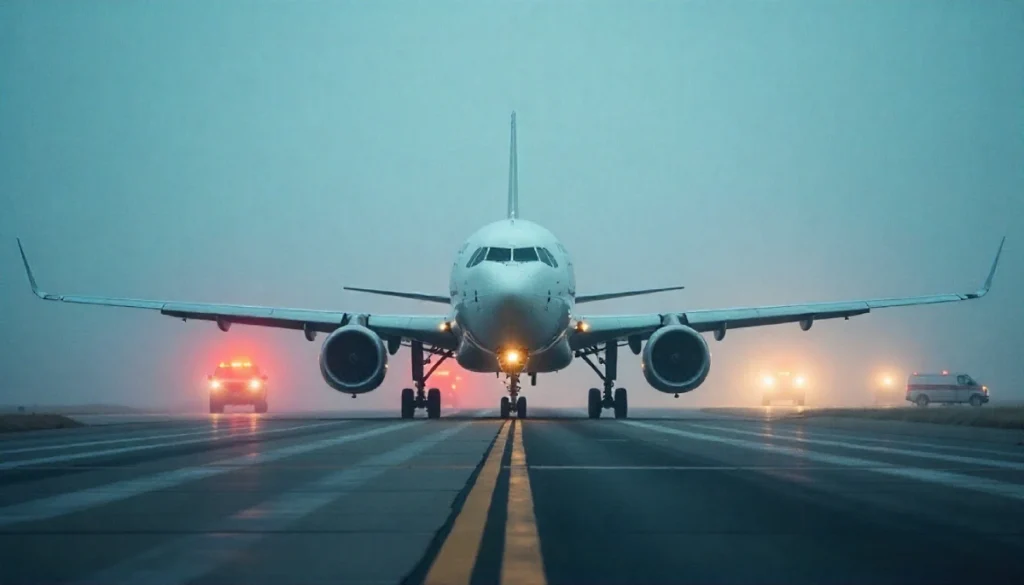
Air travel is generally safe, but history has seen a few truly shocking airplane incidents. These disasters – from massive runway collisions to mysterious disappearances and acts of terrorism – changed aviation forever.
Below are seven of the most astonishing air disasters in history, including what happened, why it was tragic, and what lessons were learned along the way.
1. Tenerife Runway Collision (1977)
In March 1977, heavy fog and miscommunication set the stage for a nightmarish disaster at Los Rodeos Airport (Tenerife, Spain). Two Boeing 747 jumbo jets – KLM Flight 4805 and Pan Am Flight 1736 – collided on the runway when the KLM crew mistakenly began takeoff without clear permission. The impact and ensuing fire killed 583 people (all 248 on the KLM jet and 335 of 396 on the Pan Am jet), with only 61 survivors. This remains the deadliest accident in aviation history.
Investigators found the root cause was a misunderstood clearance and poor radio communication. The tragedy led to crucial safety changes: pilots and air traffic controllers adopted standardized phraseology, and airlines introduced crew resource management (CRM) training to prevent such fatal misunderstandings.
2. Japan Airlines Flight 123 (1985)
Monument to the victims of Japan Airlines Flight 123 near the crash site (Ueno, Japan). On August 12, 1985, Japan Airlines Flight 123 suffered a catastrophic in-flight failure. A faulty repair on the aft pressure bulkhead (from a tailstrike years earlier) caused the bulkhead to rupture 12 minutes after takeoff. The resulting explosive decompression blew off the tail and destroyed all four hydraulic systems, leaving the massive Boeing 747-146SR uncontrollable.
The crew fought to regain control for 32 minutes, but the aircraft ultimately plunged into a mountain in Gunma Prefecture. Of the 524 people on board, only four survived – making it the deadliest single-aircraft accident ever recorded. The official investigation confirmed the decompression failure was due to the improper bulkhead repair. The crash prompted stricter maintenance inspections and emphasized the need for redundancy in flight systems.
3. Charkhi Dadri Mid-air Collision (1996)
On November 12, 1996, Saudi Arabian Airlines Flight 763 (a Boeing 747) and Kazakhstan Airlines Flight 1907 (an Ilyushin Il-76) collided at night over Charkhi Dadri, near Delhi, India. The two planes were cleared to fly at different altitudes, but the Kazakh crew descended below their assigned level and struck the Saudi jet. All 349 people on both aircraft were killed, making it the deadliest mid-air collision in history. Investigators determined the Kazakh pilots’ failure to maintain the correct altitude was to blame, aggravated by poor English language proficiency and cockpit communication issues.
At the time, Delhi’s airspace lacked secondary radar to catch the error. In response, India mandated improved air traffic control radar and stronger crew training on clear communication. This disaster underscored the importance of reliable ATC systems and strict altitude verification to prevent air travel disasters.
4. Turkish Airlines Flight 981 (1974)
In early 1974, a critical design flaw led to a horrific crash. On March 3, 1974, Turkish Airlines Flight 981 (a McDonnell Douglas DC-10) departed Paris en route to London. Minutes after takeoff, a rear cargo door blew off due to a latch design fault. The explosive decompression tore a hole in the cabin floor and severed vital control cables. The DC-10 dove into the Ermenonville Forest outside Paris, killing all 346 people aboard (335 passengers and 11 crew).
At the time, it was the deadliest aviation accident in France. The cause was traced to the cargo door not being properly latched – a known design issue in the DC-10. This tragedy forced Boeing (the DC-10’s maker) and regulators to redesign and reinforce cargo doors and improve inspection procedures. It also highlighted how a single mechanical failure can lead to complete loss of control, shaping future safety regulations for aircraft cabin integrity.
5. Air India Flight 182 Bombing (1985)
The bombing of Air India Flight 182 is one of the most shocking terrorist incidents involving a passenger plane. On June 23, 1985, a bomb planted in the luggage compartment detonated as the Boeing 747 flew over the Atlantic Ocean off the coast of Ireland. The explosion broke the aircraft apart at 9,500 meters (31,000 ft) altitude. All 329 people aboard – mostly Canadians and Indians – were killed. No one survived.
This attack (linked to Sikh militants seeking a separate state) was at the time the deadliest act of aviation terrorism and remains Canada’s worst mass-murder event. Investigators later identified Sikh extremist group members as responsible. The tragedy led Canada and other countries to tighten airport security and baggage screening, especially on flights with stopovers. It showed that hijacking was not the only threat; bombs hidden in passenger planes could also cause catastrophic loss of life.
6. Malaysia Airlines Flight MH370 (2014)
Perhaps no aviation mystery is more haunting than the disappearance of Malaysia Airlines Flight 370. On March 8, 2014, the Boeing 777 vanished from radar less than an hour after departing Kuala Lumpur for Beijing. There were 227 passengers and 12 crew on board. Despite the largest search in aviation history, the plane was never found. Only debris confirmed to be from MH370 washed ashore on remote islands thousands of miles from the crash site.
The lack of clear wreckage or distress signals means the exact cause remains unknown. The incident baffled experts and led to new tracking measures (like mandatory real-time position reporting over oceans) to ensure airline accidents can be located quickly. MH370’s vanishing highlights that even with advanced technology, a transoceanic flight can slip out of sight – a truly unbelievable event for modern aviation.
7. September 11, 2001 Terrorist Attacks
The September 11 attacks were a coordinated act of air terrorism that killed nearly 3,000 people and forever changed aviation security. On the morning of Sept. 11, 2001, four commercial jets were hijacked by terrorists. Two planes were deliberately flown into the Twin Towers of the World Trade Center in New York City, one plane struck the Pentagon near Washington, D.C., and the fourth crashed in a Pennsylvania field after passengers attempted to retake control. In total, 2,977 people died, including the hijackers.
These tragic crashes – engineered to target iconic buildings – shocked the world. Afterward, governments worldwide introduced stringent new measures: fortified cockpit doors, expanded passenger screening, and the creation of the U.S. Transportation Security Administration (TSA), among others. The 9/11 disaster showed that hijacked airliners could be used as deadly weapons, making the sky itself a new theater of terrorism and illustrating how aviation disasters have broad, global impacts.
Final Thoughts
Each of these incidents – though different in cause – taught major lessons. Today’s flight safety is shaped by the radio protocols, training programs, security rules, and design changes implemented after these shocking airplane incidents. Modern passengers can take comfort that after each tragedy, investigators and regulators have worked hard to prevent a repeat.
Contemporary accident reports and reputable histories of each incident have been used to compile these summaries. Each reference corresponds to detailed information on the specific event.
