
Flying is one of the safest forms of travel, a fact built upon rigorous engineering, strict procedures, and hard-learned lessons. Yet, within aviation’s vast history, there exist bizarre true plane crashes and peculiar flight events that defy easy explanation. These strange aviation incidents are more than just footnotes; they are captivating stories of mystery, chilling coincidence, and sometimes, unbelievable survival.
This article explores some of the most obscure air crashes and weird airplane stories that continue to intrigue us, reminding us that the sky, for all our mastery of it, can still hold profound mysteries.
The Phantom in the Machine: Hauntings and Eerie Encounters
Some aviation tales venture beyond mechanical failure or human error into the realm of the supernatural. These stories, often passed down among crew members, speak of ghostly apparitions and inexplicable phenomena that have become legendary in aviation circles.
The most famous is undoubtedly the story of Eastern Airlines Flight 401. After the tragic crash of the Lockheed L-1011 TriStar in the Florida Everglades in 1972, parts salvaged from the wreckage were used as spare parts in other aircraft within the airline’s fleet. Soon after, crews began reporting eerie encounters. Flight attendants claimed to see the apparition of Captain Robert Loft sitting in a passenger seat, while the ghost of Flight Engineer Don Repo was said to appear in the cockpits and galleys of planes fitted with the salvaged parts. Repo’s spirit was even described as a silent protector, sometimes pointing out potential mechanical issues. The stories became so persistent and unnerving for staff that Eastern Airlines eventually removed all the salvaged components from its aircraft.
Other ghostly tales are more modern and technological. In one reported incident, a co-pilot on approach to Newark Liberty International Airport saw the navigation display flicker and fill with a chilling, personalized message: “DON’T YOUUU WISHH YOOUU KNEWW WHATT THIS MEANS”. Both pilots confirmed the text before it vanished as suddenly as it appeared, leaving behind no explanation—software glitch, network error, or something else entirely.
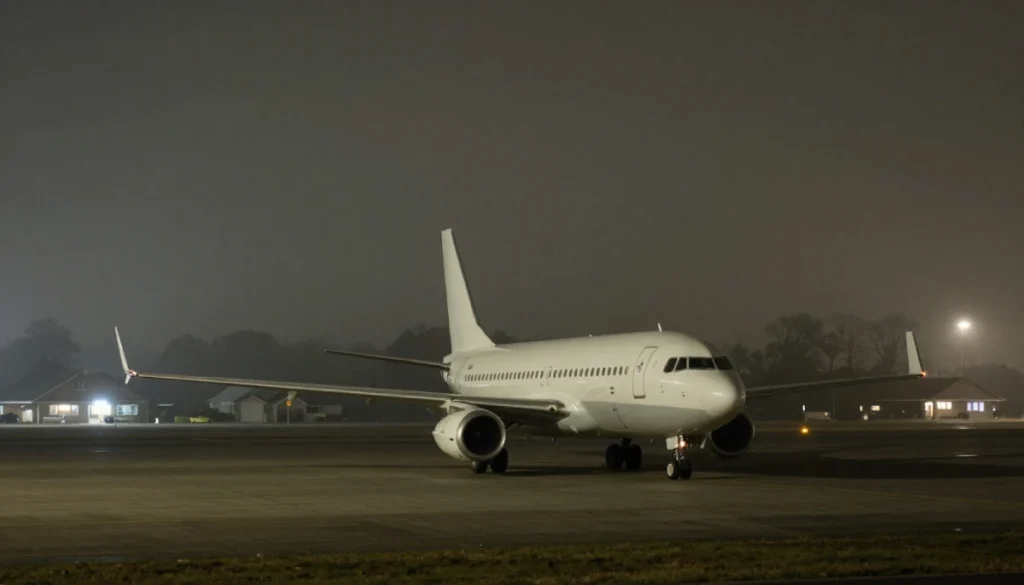
[Image suggestion: A moody, black-and-white photograph of an older Lockheed L-1011 TriStar on a foggy tarmac, evoking the atmosphere of the Flight 401 legend.]
Vanished Without a Trace: The Enduring Mystery of Missing Aircraft
The most baffling aviation incidents are those where aircraft disappear completely. These unsolved mysteries, often over vast oceans, leave investigators and the public with only questions.
The 2014 disappearance of Malaysia Airlines Flight MH370 is the most famous modern example. The Boeing 777 vanished from radar over the South China Sea with 239 people on board. Military radar indicated it made a dramatic, unexplained turn and flew for hours toward the southern Indian Ocean before the signal was lost. The largest maritime search in history found nothing but a few pieces of debris on distant shores. The official report concluded the flight path was changed manually but could not determine why, leaving the ultimate fate of MH370 as one of aviation’s greatest enigmas.
History is filled with similar stories. In 1962, Flying Tiger Line Flight 739, a charter flight carrying U.S. Army Rangers to Vietnam, vanished in perfect weather over the western Pacific. An enormous search found no wreckage, though a tanker crew reported seeing an “intensely luminous” explosion in the sky around the time and place of the disappearance. Similarly, Pan Am Flight 7, a luxurious “ocean liner of the air,” disappeared on a 1957 flight from San Francisco to Honolulu. Wreckage and some bodies were found days later, but the cause—despite traces of carbon monoxide in the victims—was never determined.
Sabotage and Strange Crimes: Deliberate Acts in the Sky
Some of aviation’s darkest and strangest tales involve deliberate acts of sabotage. These are not accidents, but chilling crimes that have shaped security protocols.
One of the first proven cases occurred on United Air Lines Flight 23 in 1933. The Boeing 247 exploded in mid-air over Indiana. FBI investigation files, declassified decades later, revealed a complex scene with evidence pointing to an intentional bombing, though a suspect was never identified. This case set a grim precedent.
Even more macabre are the plots for financial gain. In 1949, Albert Guay conspired to murder his wife by placing a bomb on the DC-3 she was traveling on. The explosion killed all 23 people on board. In a similarly cold-blooded 1955 case, Jack Gilbert Graham placed dynamite in his mother’s luggage to collect life insurance, destroying United Air Lines Flight 629 and killing 44 people. He was later convicted and executed. These tragic events highlighted the need for better passenger and baggage screening, influencing the security measures we have today.
[Image suggestion: A historical black-and-white news photo of investigators sifting through aircraft wreckage in a field, representing the early days of crash investigation.]
Fact vs. Fiction: Debunking Aviation’s Greatest Myths
The world of strange airplane stories inevitably attracts pure fiction. Some tales are so compelling that they are often mistaken for truth, but they originate from the pages of supermarket tabloids.
One enduring myth is that of Pan Am Flight 914. The story claims a Douglas DC-4 disappeared in 1955 and suddenly reappeared in 1985 in Caracas, Venezuela, with passengers who hadn’t aged a day. Another, Santiago Flight 513, tells of a 1954 flight that landed in 1989 with a cabin full of skeletons. Both stories were invented by the now-defunct Weekly World News tabloid and bear a striking resemblance to a plot from The Twilight Zone. No credible evidence supports their existence.
Even some supposedly “haunted” locations have been officially debunked. The National Museum of the U.S. Air Force, rumored to be full of ghostly activity, has stated clearly: “There has been no physical evidence to support the theory… No ‘ghostly’ sightings have been officially reported or documented”.
The “Gimli Glider”: A Story of Incredible Improvisation
Not all strange stories end in tragedy. Some are remarkable tales of skill and composure that turned potential disaster into what is now called a “miracle.”
One of the most famous is the 1983 incident of Air Canada Flight 143, the “Gimli Glider.” The brand-new Boeing 767 ran out of fuel at 41,000 feet over Canada due to a catastrophic error in converting between metric and imperial units during fuel calculation. With both engines dead, the cockpit went dark and silent. The pilots, facing a complete electrical failure, had to glide the massive jetliner—a maneuver never practiced in a 767—to a safe landing.
Their chosen site was a decommissioned Royal Canadian Air Force base in Gimli, Manitoba, which had been converted into a racetrack. As they approached, the pilots discovered the runway was being used for a car event, filled with families and racing cars. Using sheer nerve and expert airmanship, they maneuvered the plane onto the narrow runway, using the aircraft’s nose gear to help brake. The landing was so hard it collapsed the nose gear, but all 61 people on board survived with only minor injuries. This incredible event led to major changes in fuel measurement procedures and crew training worldwide.
Lessons Learned in the Aftermath
What makes these strange aviation incidents so important is that they almost always lead to concrete changes that make flying safer for everyone. The bizarre and tragic are catalysts for improvement.
- Technical Failures Lead to Better Design: The explosive decompression of Aloha Airlines Flight 243 in 1988, caused by metal fatigue, led to the creation of the National Aging Aircraft Research Program and stricter inspection rules for older planes.
- Crew Communication Saves Lives: The 1978 crash of United Airlines Flight 173, where a preoccupied captain ignored fuel warnings, directly led to the industry-wide adoption of Cockpit Resource Management (CRM) training. This system emphasizes teamwork and communication, ensuring all crew members speak up.
- Fire Prevention Becomes Paramount: A deadly lavatory fire on Air Canada Flight 797 in 1983 resulted in mandates for smoke detectors and automatic fire extinguishers in airplane bathrooms, as well as flame-resistant interior materials.
These stories remind us that the high safety standards of modern aviation are not a given. They are a hard-won legacy, paid for with lessons learned from the strangest, most tragic, and most miraculous moments in flight history.
