
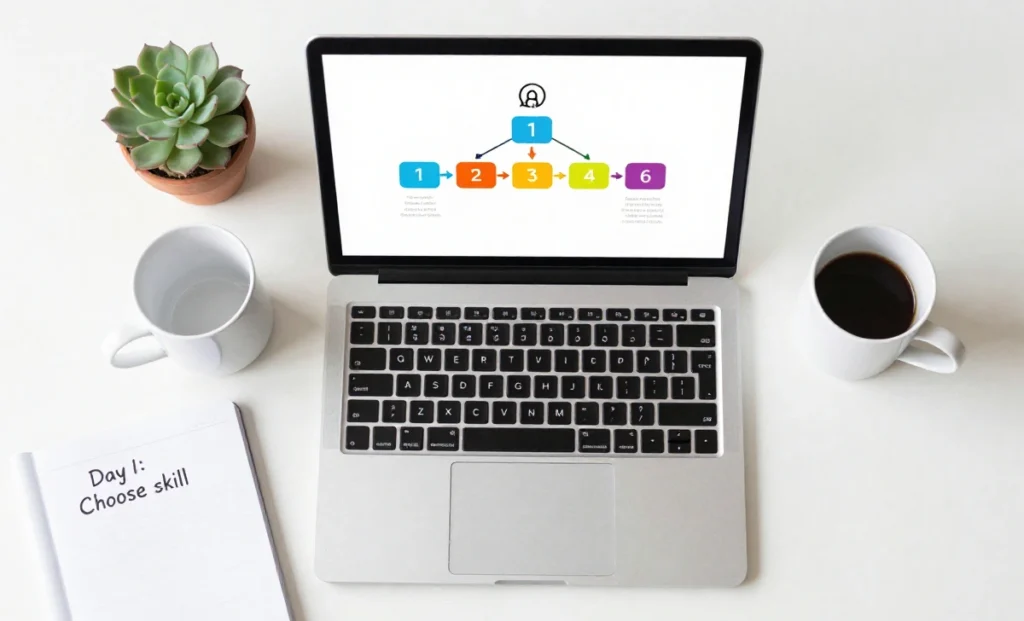
Here’s the truth nobody tells you: You don’t need to master SEO, PPC, email marketing, social media, and content strategy before landing your first client. You need one skill. One offer. One paying customer who validates that you can actually do this.
This guide is your digital marketing roadmap for beginners. Not another dump of everything you could possibly learn. Instead, I’m giving you the minimum viable path from complete newbie to freelancer with a paying client. No fluff. No courses to buy. No tools that cost money.
By the end of this roadmap, you will know:
- Which single digital marketing skill to learn first (based on your personality and goals)
- How to learn that skill for free in 14 days or less
- Exactly how to find and land your first client—even with zero portfolio
- What to charge and how to deliver work without feeling like an imposter
Time commitment: 2-3 hours per day for 3 weeks
Budget required: $0
Difficulty: You can do this. I promise.
What Actually Is a Digital Marketing Roadmap?
A digital marketing roadmap is not a list of everything you’ll eventually learn. It’s a strategic filter that helps you ignore 90% of available information so you can focus on the 10% that gets you paid.
Think of it like GPS navigation. When you input a destination, the GPS doesn’t show you every single road in the country. It shows you one route and tells you to ignore everything else. That’s what this guide does.
Most beginners fail because they try to learn everything simultaneously. They study SEO for two days, get bored, switch to Facebook ads, get overwhelmed by the bidding system, and then start watching Instagram Reels tutorials. Three months later, they know a little about a lot—and nothing well enough to sell.
This roadmap prevents that. You will learn one thing, practice it, package it, and sell it. Then you repeat the process with the next skill.
Phase 1: Choose Your Path—Which Skill Should You Learn First?
Not all digital marketing skills are equal for beginners. Some require significant budgets (PPC ads). Some take months to show results (SEO). Some have low barriers to entry but high demand.
Use this decision framework to choose your starting skill.
Option A: Content Writing & Blogging
Best for: Writers, researchers, detail-oriented people. What you sell: Blog posts, articles, and email newsletter Average beginner rate: $50–$150 per post. Time to first client: 2–4 weeks. Pros: Zero budget needed, high demand, improves with practice. Cons: Competitive, requires good English skills
Option B: Social Media Management
Best for: Creative people, trend-spotters, community builders. What you sell: Content calendars, posting, engagement, and simple growth strategies. Average beginner rate: $300–$800/month per client. Time to first client: 1–3 weeks. Pros: Visual portfolios are easy to create, recurring revenue. Cons: Algorithm changes, clients expect quick growth
Option C: Email Marketing
Best for: Analytical thinkers, sales-minded people. What you sell: Newsletter setup, welcome sequences, broadcast emails. Average beginner rate: $200–$500 setup + monthly retainer. Time to first client: 2–4 weeks. Pros: Highest ROI channel, less competition than social. Cons: Requires understanding email platforms (free tiers available)
Option D: Basic SEO (On-Page)
Best for: Technical thinkers, patient people. What you sell: Keyword research, on-page optimization, and basic audits. Average beginner rate: $100–$300 per audit or project. Time to first client: 3–5 weeks. Pros: Less subjective than creative work, measurable results. Cons: Slower to show results, requires understanding search intent
⚠️ Warning: Do NOT start with PPC advertising or advanced analytics. These require a budget (client or your own) and deeper technical knowledge. Save them for Phase 2 or 3.
Your task today: Choose ONE skill from the four options above. Not two. Not “I’ll learn social media and see if I like it.” Pick one and commit for 30 days.
Phase 2: Learn the Essentials Without Information Overload
Once you’ve chosen your skill, you need a bounded learning plan. Not “learn everything about email marketing.” Instead: “Learn exactly what I need to deliver one service for one client.”
The 80/20 Learning Framework
For each skill, focus on mastering these core competencies before anything else:
If you chose Content Writing:
- How to write a headline that makes people click
- Basic blog post structure (intro, body, conclusion)
- How to research a topic using free tools
- Formatting for readability (short paragraphs, subheadings)
- One simple call-to-action
Stop learning: Advanced SEO writing, pillar pages, content clusters, and guest posting outreach.
If you chose Social Media Management:
- How to create a content calendar (Google Sheets is fine)
- How to design basic graphics using Canva (free)
- How to schedule posts using a free tool
- How to write engaging captions
- Basic community management (responding to comments)
Stop learning: Facebook ads manager, influencer marketing, viral growth hacks, Reels editing.
If you chose Email Marketing:
- How to set up a free Mailchimp account
- How to create a signup form
- How to write a 3-email welcome sequence
- Basic list segmentation
- How to interpret open rates and click rates
Stop learning: Marketing automation workflows, SMS marketing, deliverability optimization, A/B testing.
If you chose Basic SEO:
- What keywords are and how to find them (Google Keyword Planner is free)
- How to optimize a page title and meta description
- Header tag structure (H1, H2, H3)
- Basic internal linking
- How to run a free SEO audit using Google Search Console
Stop learning: Link building, technical SEO, schema markup, Core Web Vitals.
Free learning resources:
- Google Digital Garage – Fundamentals of Digital Marketing (40 hours, free certification)
- HubSpot Academy – Social Media, Content Marketing, Email Marketing certifications
- YouTube – Search ” [your skill] for beginners 2026.”
- Canva Design School – Free social media graphic tutorials
Your task this week: Spend 2 hours per day on your chosen skill. Follow the 80/20 list. Ignore everything else.
Phase 3: Build Your Freelance Foundation (Zero Budget)
You don’t need a website. You don’t need business cards. You don’t need expensive software. Here’s exactly what you need to appear professional and ready to work.
What You Actually Need:
LinkedIn Profile (Free)
- Professional photo (good lighting, plain background)
- Headline that says what you do: “Social Media Manager helping small businesses grow on Instagram.”
- The section that mentions your specific skill and who you help
- Featured section with 2-3 examples of your work
Portfolio Examples (Free) You don’t need paid clients to have a portfolio. Create samples:
- Content writer: Write 3 blog posts on topics relevant to your niche. Publish on Medium or LinkedIn Articles.
- Social media manager: Create a 30-day content calendar for a hypothetical bakery, fitness coach, or real estate agent.
- Email marketer: Write a 5-email welcome sequence for a fictional brand.
- SEO specialist: Audit a real website (a friend’s business or local restaurant) and document your recommendations.
Service Offer (One Page) Write a simple document answering:
- What specific service do you offer?
- Who is it for?
- What results can they expect?
- What is your process?
- What is your price?
Free Tools Starter Kit
- Canva – Graphics and simple PDF proposals
- Google Drive – Proposals, contracts, reports
- Mailchimp – Free email marketing up to 500 contacts
- Notion – Project management and content calendars
- Calendly – Free booking link for discovery calls
Your task this week: Complete all four setup items above. Do not move to client hunting until your foundation is ready.
For a complete, fill-in-the-blank framework that walks you through every section of your marketing foundation—including buyer personas, channel selection, and budget planning—download the Ultimate Digital Marketing Plan Template. It’s free and used by thousands of beginners to build their strategic roadmap.
Phase 4: Find Your First Client (7 Proven Strategies)
This is where most beginners freeze. “I don’t have experience. I don’t have testimonials. Who would pay me?”
Here’s the secret: Your first client isn’t looking for a world-class expert. They’re looking for someone responsive, coachable, and reasonably priced. You can be all three today.
Strategy 1: Your Existing Network
Make a list of 20 people you already know: former colleagues, friends who own businesses, family members with side hustles, and alumni from your school. Send this message:
“Hi [Name], I’m building my freelance [skill] business and offering a special rate to my first few clients. I noticed you [have a business / sell products / have a website]. Would you be open to a free 15-minute audit of your [social media/website / email]? No obligation.”
Strategy 2: Local Businesses (No Portfolio Needed)
Walk into local coffee shops, boutiques, restaurants, or service businesses. Ask: “Who manages your social media?” or “Do you ever need help with blog posts?”
Small local owners rarely have dedicated marketing help. They’re overwhelmed and open to affordable assistance.
Strategy 3: Upwork (Strategic Bidding)
Upwork has a bad reputation among experienced freelancers, but it’s excellent for beginners. Filter for jobs posted within 24 hours. Write proposals that:
- Reference something specific from their job post
- Show you read and understood their problem
- Offer a small paid trial (e.g., “I’ll write one blog post for $30. If you like it, we can discuss ongoing work.”)
Strategy 4: Facebook Groups
Join 3-5 Facebook groups where your target audience hangs out. Do not post “HIRE ME.” Instead, spend 3 days answering questions thoughtfully. On day 4, post: “I’m a [skill] specialist currently taking on 2 pro-bono projects to build my portfolio. If you need help with [specific problem], comment below or DM me.”
Strategy 5: Cold Email with Value
Find 10 businesses with outdated websites, inactive social media, or no blog. Spend 15 minutes per business identifying ONE specific improvement. Email them: “Subject: Quick observation about [business name] Hi [Name], I’m a [skill] specialist. I noticed [specific issue, e.g., your Instagram hasn’t posted in 3 weeks]. I wrote a suggested caption and content idea for your next post—no charge, just thought it might help. If you’d like more ideas, I’m offering a special rate for my first clients.”
Strategy 6: Partner with Agencies
Marketing agencies often need freelance help when they’re overloaded. Search LinkedIn for “digital marketing agency [your city]” or “content marketing agency.” Find the owner or head of operations. Send: “Hi [Name], I’m a freelance [skill] specialist looking to partner with agencies as overflow help. Do you ever need additional support on client work? I’d love to send my rates and availability.”
Strategy 7: Your Own 7-Day Sprint
Commit to one week of focused outreach. Set a goal: 50 connection requests on LinkedIn, 10 cold emails, 5 in-person visits, or 5 Upwork proposals. Track everything. Adjust based on what gets responses.
Warning: Do not wait until you feel “ready.” You will never feel ready. Start outreach when your foundation is 70% complete, not 100%.
Before you start outreach, make sure you’re not unknowingly scaring potential clients away. Many beginners make critical errors that sabotage their first impression. Read 7 Digital Marketing Mistakes Costing You Clients in 2026 to identify and fix these invisible trust-killers before you send your first proposal.
Phase 5: Deliver Your First Project (Without Panic)
You got a yes. Now what? Imposter syndrome will hit hard. Here’s how to deliver professional work as a beginner.
The First Client Delivery Checklist
Before You Start:
- Confirm the scope in writing (email is fine)
- Agree on timeline and deliverables
- Ask for the access they need to provide (passwords, analytics, etc.)
- Set a check-in point halfway through
During the Project:
- Over-communicate. Send a quick update: “Starting your blog post today, outline by Wednesday.”
- Ask questions if anything is unclear. Clients respect this.
- Deliver early if possible. Under-promise and over-deliver.
At Delivery:
- Send a professional email with a clear subject line
- Explain what you did and why
- Include next steps or recommendations
- Ask for feedback
After Delivery:
- Send a simple thank you
- Request a testimonial (template below)
- Ask if they need ongoing help
Testimonial Request Template
“Hi [Client], I’m so glad you were happy with the [project name]. Would you be open to writing 1-2 sentences about your experience? Something like: ‘What problem can I help you solve?’ and ‘What result did you see?’ This helps me show future clients what it’s like to work with me.”
Pro Tip: Your first client is not just revenue. They are your case study, testimonial, and referral source. Treat them like gold.
Phase 6: From One Client to Consistent Income
Your first client validates your business model. Now you need to build momentum.
The Repeatable Client System
1. Increase Your Rate. After delivering excellent work for your first client, raise your price for the next one. Even 20-30%. You have proof now.
2. Ask for Referrals “I’m currently looking to take on 2-3 more clients. Do you know any other business owners who might need help with [your skill]?”
3. Repurpose Your Success: Turn your first client project into a case study:
- The challenge they faced
- What you did
- The results (even small wins count)
- Their testimonial
Post this on LinkedIn, your portfolio, and include it in future proposals.
4. Stack Your Skills Once you have a consistent income from Skill #1, invest 1 hour per day learning Skill #2. Now you can offer packages, raise rates, and solve bigger problems.
5 Common Roadblocks That Keep Beginners Stuck
1. Perfectionism
The problem: “My portfolio isn’t good enough. My website isn’t live. I need one more course.” The fix: Launch before you’re ready. Good enough executed beats perfect never started.
2. Imposter Syndrome
The problem: “I only know basic stuff. What if they ask me something I don’t know?” The fix: “I don’t know, let me research that and get back to you” is an acceptable answer. Clients respect honesty.
3. Undercharging
The problem: “I’ll charge $20 for a whole website audit because I’m new.” The fix: Price based on value, not hours. If you save a client 10 hours of work, $100 is reasonable even if it took you 2 hours.
4. Shiny Object Syndrome
The problem: Starting with SEO, switching to Facebook ads, and trying email marketing, all in two weeks. The fix: Commit to one skill for 90 days. No exceptions.
5. Isolation
The problem: Working alone, no feedback, no accountability. The fix: Join one community. Twitter (X) for digital marketers, Reddit’s r/freelance, or a free Discord group. Find 2-3 peers at the same level.
If you’re feeling stuck in overwhelm and just need a shock-start to get moving, follow this tactical 7-Day Digital Marketing Plan. It’s a zero-budget sprint designed specifically for absolute beginners to launch their first campaign—and their first client conversation—in one week.
Frequently Asked Questions
How long does it really take to get the first client?
If you follow this roadmap and do outreach daily, 2-4 weeks is realistic. The biggest variable is your activity level. 10 cold emails per day will get you a client faster than 50 perfect portfolio pieces.
Do I need a certification to get hired?
No. Certifications help you learn, but clients rarely ask for them. Your portfolio samples and how you communicate matter far more.
What if I have zero budget for tools?
You don’t need any. Every tool mentioned in this guide has a free tier. Canva, Mailchimp, Google Analytics, Google Keyword Planner, LinkedIn—all free. Upgrade only after you have paying clients.
Which skill pays the most for beginners?
Email marketing and SEO typically command higher beginner rates than social media management, which is more saturated. However, the “best” skill is the one you will actually do consistently.
How do I handle a client who asks for something I don’t know?
Be honest. “I haven’t done that specific thing before, but I’m confident I can figure it out. If you’re open to me learning on the job, I’ll discount the rate for this first time.” Most clients appreciate the transparency.
Should I specialize in one industry?
Eventually, yes, but not yet. For your first 3-5 clients, take anyone who will pay you. You’ll naturally discover which industries you enjoy and which types of projects you’re best at.
What if my first campaign gets zero responses?
That’s data, not failure. Your offer might be unclear, your targeting might be wrong, or your channel might not be where your audience is. Change one variable and try again. Persistence beats talent.
