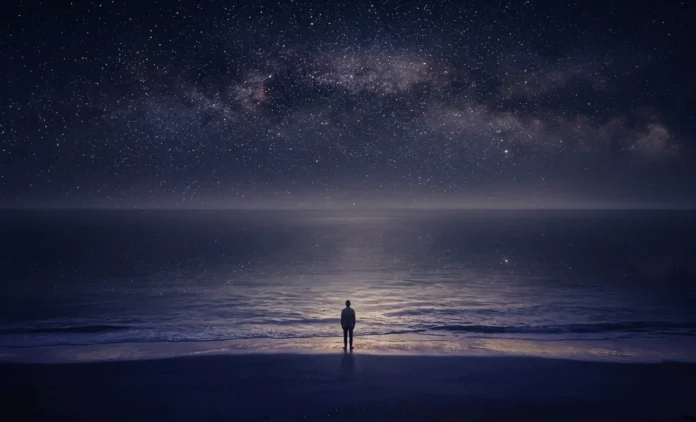
Some words do more than describe. They point at something you’ve felt but couldn’t name.
Immensheid is one of those words.
If you’ve ever stood at the edge of the ocean and felt something between awe and smallness, or looked up at a night sky full of stars and felt your thoughts go quiet — you’ve already touched what immensheid is trying to say.
Let’s unpack what it actually means, where it comes from, and why it carries more weight than most people expect.
What Is Immensheid?
Immensheid is a Dutch word. Its direct English translation is immensity — but that single word barely covers it.
In Dutch, immensheid is built from immens (immense, vast, boundless) and the suffix -heid, which converts an adjective into an abstract noun. So immensheid doesn’t just mean something is large. It names the quality of being without a measurable limit. The state of being so vast that scale itself stops making sense.
Think of it this way:
- A mountain is big.
- The ocean is large.
- The universe is… immensheid.
It’s the difference between a measurement and an experience.
Immensheid vs. Infinity: Are They the Same Thing?
Not quite — and the distinction matters.
Infinity is a mathematical concept. It’s precise, abstract, and lives comfortably in equations. Infinity says: there is no end. It’s a logical statement.
Immensheid is experiential. It’s what happens to a person when they encounter something that feels beyond their ability to hold in mind. It’s not just “no end” — it’s the felt weight of that endlessness.
Here’s a cleaner way to see the difference:
| Infinity | Immensheid | |
|---|---|---|
| Domain | Mathematics/logic | Human experience/perception |
| Nature | Abstract concept | Felt quality |
| Example | The set of all numbers | Standing under a clear night sky |
| Key question | Does it end? | How does vastness feel? |
Infinity is something you calculate. Immensheid is something you experience.
Philosophers have circled this distinction for centuries without always naming it. Edmund Burke, Immanuel Kant, and later thinkers writing about the sublime were all, in different ways, describing immensheid — that encounter with something so large it temporarily overwhelms your ability to process it.
The Philosophy Behind Immensheid
The Sublime and Its Link to Vastness
Kant’s concept of the mathematical sublime comes closest to immensheid in Western philosophy. He described moments when the imagination tries to grasp something — say, the height of a mountain range or the depth of the cosmos — and fails. That failure isn’t a defeat. It’s the trigger for a kind of mental expansion.
You try to measure. You can’t. And in that gap, something shifts.
Immensheid lives in that gap.
Immensheid in Phenomenology
Phenomenology — the branch of philosophy concerned with first-person experience — offers another lens. Thinkers like Gaston Bachelard wrote directly about vastness as a psychological state, not just a physical one. In The Poetics of Space, Bachelard argued that the mind has its own kind of immensity. That internal space and external space mirror each other.
In this reading, immensheid isn’t only about the universe. It’s about the capacity of human consciousness to reach toward what it cannot fully contain.
Immensheid in Everyday Human Life
You don’t need to be a philosopher to experience immensheid. It shows up in ordinary moments, often without warning.
1. Looking at the Night Sky
The most common trigger. The Milky Way contains somewhere between 100 and 400 billion stars. The observable universe contains roughly two trillion galaxies. Those numbers don’t land emotionally as numbers. They land as immensheid — a sudden, quiet recognition that scale has outrun comprehension.
2. Standing Before the Ocean
The horizon line does something specific to human perception. It shows you the limit of what you can see — while making clear that what you can’t see continues indefinitely. That tension is immense in physical form.
3. Deep Grief or Deep Love
Immensheid doesn’t only point outward. Profound emotional experiences — loving someone deeply, losing someone suddenly — can produce an internal version of the same feeling. The sense that something is larger than your ability to hold it.
4. Reading History or Science at Scale
Sitting with the fact that Earth is 4.5 billion years old, or that human civilisation covers roughly 0.0001% of the planet’s timeline — that quiet disorientation is immenseness working on your perception of time.
Why Immensheid Matters (More Than You’d Think)
Understanding this concept isn’t an academic exercise. It has real effects on how people think and behave.
Research in psychology — particularly around the emotion of awe — shows that encounters with vast, perspective-shifting experiences produce measurable changes in people. They become temporarily less self-focused. They report feeling more connected to others. They make more generous decisions in the short term.
Psychologists Dacher Keltner and Jonathan Haidt have studied awe extensively and describe it as a response to something vast that challenges your existing mental structures. That’s immensheid, translated into behavioural science.
There’s also a philosophical argument for actively seeking it. If immensheid temporarily loosens the grip of ego, routine thinking, and small concerns, it might be one of the more honest resets the human mind has access to.
How Immensheid Differs Across Cultures and Languages
Some languages have no clean translation for immensheid. English gets close with “immensity” but loses the -heid quality — the sense of it being a state of being rather than a size description.
Languages with rich philosophical vocabularies sometimes carry adjacent words:
- Japanese: Mono no aware (the bittersweet awareness of impermanence) touches the emotional dimension without the scale component.
- German: Unermesslichkeit (immeasurability) captures the size, but again, in a more objective register.
- Sanskrit: Ananta (without end) is close, but functions primarily as a spiritual/religious concept.
Immensheid sits at a specific intersection — scale + perception + feeling — that few single words in other languages hit as cleanly.
Common Misconceptions About Immensheid
“It just means something is very big.” No. Size is a component, but immensheid is about the experience of encountering vastness — not the vastness itself. A photograph of the ocean is not immense. Standing at the shore in silence, at night, might be.
“It’s a religious concept.” Not inherently. While immensheid overlaps with experiences described in religious and spiritual traditions, it’s a phenomenological concept. It applies equally in secular, scientific, or aesthetic contexts.
“You need to be in nature to feel it.” Nature is a common trigger, but not the only one. Reading about deep time, sitting with grief, or even contemplating the complexity of a single human cell can produce the same quality of experience.
Immensheid and Human Creativity
Artists, writers, and composers have returned to immensheid throughout history — often without naming it.
Turner’s seascape paintings tried to put it on canvas. The overwhelming fog, the light breaking through clouds too large to frame. Beethoven’s late quartets press against emotional limits that feel connected to the same territory. Writers from Rilke to Carl Sagan reached for it in language, knowing they’d fall short, and writing anyway.
That reaching — knowing the thing is too large but attempting the translation — might be one of the most human artistic impulses there is.
Conclusion
Immensheid is not a complicated concept. It’s actually a very honest one.
It names the experience of encountering something so large — physically, temporally, emotionally — that your normal frames of reference stop being useful. And rather than treating that as a problem, immensheid suggests it’s worth noticing. Worth sitting with.
The universe is not scaled to human comfort. Time is not scaled to a single lifetime. The mind, though, has the strange capacity to reach toward what it can’t contain. That reaching is the heart of immensheid.
The next time something leaves you momentarily speechless — something too large, too deep, or too beautiful for a quick response — you’ll have a word for it now.
FAQs
What does immensheid mean in English?
Immensheid is a Dutch word that translates most directly as “immensity” — but it points specifically to the felt experience of encountering something boundless or vast, beyond what the mind can easily measure or contain.
Is immensheid a philosophical term?
It functions as one, though it originates as a Dutch noun. Philosophically, it connects closely to concepts like the sublime, awe, and phenomenological studies of human perception and scale.
How is immensheid different from infinity?
Infinity is a mathematical concept dealing with the absence of limits. Immensheid is the human experience of encountering something that feels limitless — it’s perceptual and emotional rather than abstract.
Can immensheid describe emotional experiences, not just physical ones?
Yes. While landscape and astronomical scale are common triggers, immensheid can apply to deep grief, profound love, or any internal experience that feels larger than one’s capacity to fully hold or process it.
Where does the word immensheid come from?
It comes from Dutch: immens (immense/vast) + -heid (a suffix that creates abstract nouns from adjectives, similar to the English “-ness”). So it means roughly “the state or quality of being immense.”
Why do people search for immensheid?
Most people searching for this term are looking for its meaning and deeper interpretation — often because they encountered the word in a philosophical, literary, or creative context and want to understand what it actually points to.