
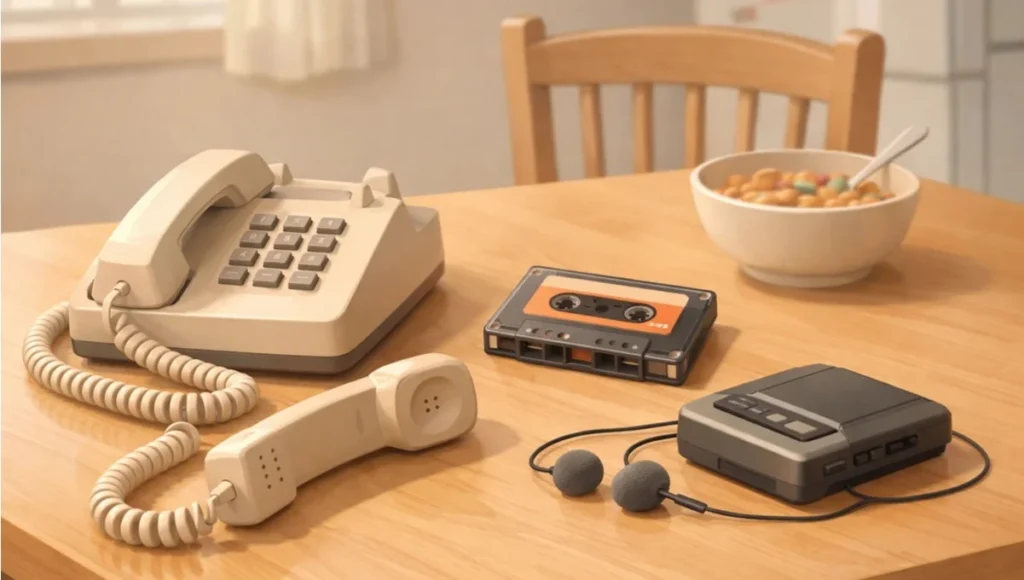
Do you ever hear a ghost? Not the spooky kind, but a voice from the past that pops into your head at the strangest moments. For many of us, that voice belongs to our mothers, repeating lines so familiar they feel etched into our DNA. These phrases are more than just words; they are cultural artifacts, secret handshakes that instantly identify you as a member of a specific generation. If your childhood was defined by playing outside until the streetlights came on and the internet was a mysterious dial-up sound, your mom likely had a unique script. This wasn’t just parenting; it was a linguistic tradition passed down through an era less concerned with negotiation and more focused on clear, if sometimes baffling, authority. Let’s take a warm, witty walk down memory lane. Here are nine quintessential mom-isms that serve as undeniable proof your formative years happened in a pre-millennium world, unpacking the hidden logic and lasting legacy behind each one.
1. “Wait Until Your Father Gets Home”
This was the ultimate disciplinary cliffhanger. It wasn’t just a threat; it was a masterclass in suspense, drawing out the consequences over hours. The power lay in the anticipation, which often felt heavier than the punishment itself. Your mind would race through every possible outcome, turning you into your own judge and jury.
This phrase highlights a very clear, mid-century family structure. Mom was the day-to-day manager, but Dad was often positioned as the final executive authority. It reflected a time when parenting roles were more segmented. The phrase transferred the weight of discipline, allowing mom a moment of respite and dad an entrance as the enforcer.
Today, with more fluid and equal parenting partnerships, this line feels almost theatrical. Modern discipline aims for immediacy and connection between the action and its consequence. Yet, for its time, it was a simple system everyone understood. It taught a lesson in patience, fear, and the hierarchical order of the household in one loaded sentence.
2. “Money Doesn’t Grow on Trees”
Every trip to the grocery store or toy aisle was a potential stage for this economics lecture. It was a visceral, tangible lesson in scarcity and value. In an age before one-click purchases, money was physical—allowances were in cash, and bills were paid by check. You could see the wallet get thinner.
This mom-ism wasn’t about cruelty; it was about reality. For families living on tight budgets, often with a single income, it was a plain truth. It forced you to prioritize needs over wants and to understand that every object in your home represented labor, time, and sacrifice. It built an early awareness of finite resources.
Contrast this with today’s children, who often see money as an abstract number on a screen or a card tapped silently at a register. The phrase “money doesn’t grow on trees” attempted to root financial understanding in the physical world. It was a foundational, if simplistic, step toward financial literacy based on tangible exchange.
3. “Don’t Make Me Turn This Car Around”
The pre-digital road trip was a crucible of boredom and sibling warfare. Crammed in a backseat with nothing but your thoughts and a sibling’s elbow, conflict was inevitable. This threat from the driver’s seat was the nuclear option for restoring order. Its genius was in its plausibility.
The key was that sometimes, they absolutely would do it. The follow-through is what cemented its legendary status. Turning the car around meant sacrificing the parent’s plans, time, and gas money—a huge cost. This demonstrated that peace was non-negotiable and that misbehavior could have real, immediate, and disappointing consequences for the entire family.
It taught a lesson in collective responsibility and the social contract of a shared journey. Today, with individual screens providing constant distraction, the communal pressure cooker of the family car is less common. This phrase was the law of a confined, moving land, where the driver was the undisputed ruler.
4. “Because I Said So”
The definitive end to any debate. In an era before “explain your reasoning” became a parenting mantra, this was the ultimate appeal to authority. It offered no justification, no life lesson wrapped in a bow. It was a direct communication of the chain of command.
Modern parenting advice rightly critiques this for missing teachable moments. However, its defenders would argue it prepared kids for a world filled with irrational bosses, inexplicable rules, and situations where “why” simply has no satisfying answer. It taught compliance, for better or worse, and established a clear boundary that questioning had limits.
This phrase operated on a foundation of implicit trust. The underlying assumption was that the parent’s authority was legitimate and their motives were sound, even if inscrutable. It was a shorthand that saved time and energy in busy households, reinforcing that not every directive comes with a democratic process attached.
5. “If Your Friends Jumped Off a Bridge, Would You Do It Too?”
This was the go-to retort for the dreaded peer pressure argument of “But everyone else is doing it!” It used absurdity to highlight the flaw in following the herd. The goal was to provoke independent thought, to separate your own judgment from the crowd’s momentum.
It’s a phrase that feels almost charmingly small-scale now. Our mothers worried about the influence of a handful of kids at school or in the neighborhood. Today’s parents confront the influence of millions of curated personas online. The bridge has become a metaphorical TikTok trend, but the core parental anxiety about mindless imitation is magnified a thousandfold.
The lesson was about integrity and personal safety. It pushed you to be the critic, to evaluate an action based on its own merit rather than its popularity. While its delivery was sarcastic, its intent was to build a spine—to equip you with the rhetorical tool to, at least internally, question foolish consensus.
6. “I’ll Give You Something to Cry About”
To modern ears, this sounds starkly dismissive. It was typically deployed when a child’s tears were deemed disproportionate to the problem—a skinned knee, a lost toy, a denied request. The philosophy wasn’t about validating emotion; it was about building resilience through a kind of emotional shock therapy.
The idea was to toughen you up for a world perceived as harsh and unsympathetic. It framed certain emotional displays as a luxury one couldn’t afford. In an era less conversant in child psychology, this was a blunt instrument meant to stop “self-pity” and redirect focus away from the minor upset.
Today, we understand more about emotional intelligence and the importance of acknowledging feelings. This phrase, however, reveals a generational focus on grit over grace. It was an attempt, however flawed, to prepare you for disappointment and pain by minimizing smaller hurts. Its legacy is complex, often mixing remembered toughness with a wish for more comfort.
7. “Close the Door! We’re Not Heating the Entire Neighborhood”
This was a constant, pragmatic refrain, especially in colder climates. It was a lesson in energy conservation and household economics long before “carbon footprint” entered the lexicon. Every open door represented wasted money—literally letting paid-for warmth escape.
It fostered a mindset of mindfulness and collective responsibility for the home’s efficiency. You were taught to be aware of your actions on the shared system. It wasn’t just about temperature; it was about stewardship, waste-not-want-not values, and being part of a unit where every member’s actions had a cost.
With better insulation and smart thermostats, the urgency has faded. But the core principle persists. This mom-ism connected a simple, physical action (shutting a door) to a larger, abstract concept (financial responsibility and resource management). It was daily, practical training in seeing the bigger picture.
8. “There Are Children Starving in [Insert Country]”
Usually unleashed at the dinner table over uneaten broccoli, this was the guilt-trip of global proportions. Its intention was to instill gratitude and perspective by contrasting your privilege with a distant, generalized suffering. It was a heavy-handed attempt to teach you that your “problems” were, in the grand scheme, minor.
While the phrasing is now rightly seen as problematic—reducing complex issues of poverty to a simplistic rhetorical tool—the underlying impulse was moral education. Parents were trying to stretch a child’s worldview beyond their immediate desires, to cultivate appreciation for security and plenty.
The modern version of this lesson might involve volunteering or more nuanced discussions about inequality. But for its time, it was a straightforward, if clumsy, method to combat entitlement and waste. It forced you, however briefly, to consider a world much larger and harder than your own.
9. “Don’t Talk Back to Me”
Respect for authority was paramount, and this phrase drew a bright red line. Questioning or arguing with a parent’s directive was often framed not as debate, but as defiance. The hierarchy was clear: parents commanded, children complied. Explaining your side was frequently interpreted as disrespect.
This approach certainly limited opportunities for developing negotiation skills and critical argument. However, it enforced a social code of deference to elders and authority figures that was standard for the era. It taught that sometimes, especially in matters of safety or immediate instruction, swift obedience was valued over discussion.
Contemporary parenting encourages explaining boundaries and validating a child’s voice, fostering advocacy skills. The tension between these models—unquestioning respect versus respectful questioning—defines a key generational shift. This mom-ism was the guardian of a quieter, more automatically deferential household.
Final Thoughts
These mom-isms are more than nostalgic punchlines. They are linguistic fossils that reveal the values, anxieties, and social structures of a bygone era. They speak of a time of clearer hierarchies, economic mindfulness, and a parenting philosophy centered on resilience and respect, often delivered without a footnote.
Hearing these phrases today doesn’t mean your upbringing was better or worse—it was simply different. It was shaped by the realities of its time, just as today’s parenting is shaped by ours. These verbal relics connect us to a shared generational experience, a common cultural language that those raised after the 2000s might never fully decipher.
So, if you hear your mother’s voice in these lines, it’s not just a memory. It’s a badge of a particular time and place. And whether you catch yourself repeating them or consciously choose a different script, they remain a part of your story—a testament to the enduring, if ever-evolving, project of raising children.
