
Rosboxar is a modular business platform designed to connect your existing tools, automate repetitive workflows, and give teams a single place to track work. It does not replace your current software — it coordinates between them, reducing the manual effort that slips through the gaps.
If you have ever spent a Monday morning copying data from one tool into another, you already understand the problem Rosboxar is built to solve. The average employee switches between apps multiple times per hour, according to Asana’s Anatomy of Work Report. That constant context-switching does not just feel inefficient — it costs real output. Companies lose roughly 20% of annual productivity to fragmented tools and siloed communication.
Rosboxar enters that gap.
What Rosboxar Actually Is
Rosboxar is a modular workflow automation and integration platform. Rather than forcing a business to abandon its existing tools and migrate to a single all-in-one system, it acts as a coordination layer — connecting the tools you already use, automating handoffs between them, and making information visible in one unified interface.
The name breaks down practically: “Ros” points to automated, systematic operations, while “boxar” suggests modular, self-contained components — like building blocks you can reconfigure without rebuilding from scratch. That philosophy is the core of what Rosboxar does.
This approach differs from traditional software suites, which are rigid by design. If a monolithic platform does not have a feature you need, you wait for the vendor to build it. With Rosboxar’s modular structure, you add or remove components based on what your business actually requires — and nothing more.
Launched in January 2024, the platform had reached over 1,200 businesses by the end of that year and expanded into European markets in 2025 with full EU data compliance.
How Rosboxar Works
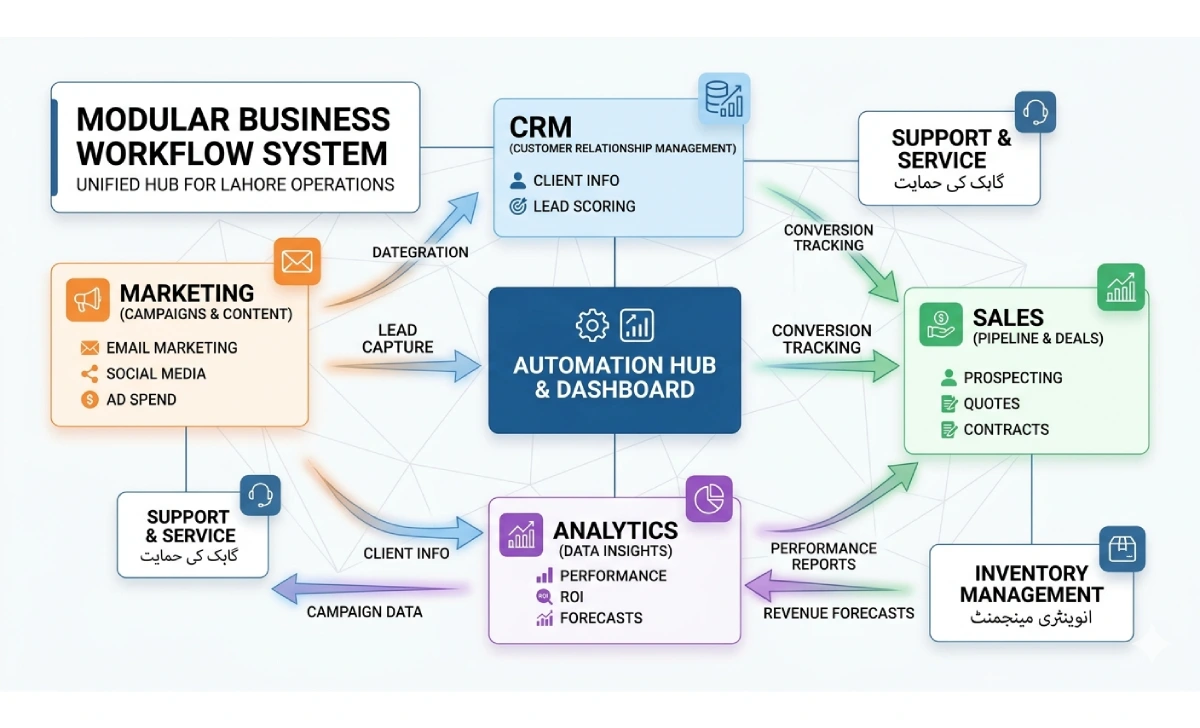
Rosboxar operates on four principles that determine how its systems are built and maintained: modularity, adaptability, composability, and scalability.
Modularity means your operations are broken into independent units. Your lead generation process, your client onboarding, your reporting — each is a separate module. Improve one without disrupting the others.
Adaptability means those modules can change as your business changes. You do not build a system for your current size and then tear it down when you grow. You extend what already works.
Scalability follows naturally: add capacity where you need it, when you need it. When a business lands a contract that doubles its workload, a Rosboxar-based setup scales with it — without a complete rebuild.
The Role of API Integrations
The technical backbone of Rosboxar is its API connectivity. Supported integrations include tools like Slack, Salesforce, Microsoft 365, Asana, and Google Workspace — reportedly over 500 third-party connections on paid plans. When a customer places an order, that data can automatically update your inventory, trigger a shipping label, and send a tracking notification — without a human in the middle.
Unified Dashboard and Automation Layer
Every connection flows into a central dashboard. Teams see the status of tasks, projects, and data from multiple tools in one view. Automation rules determine what happens when conditions are met — for example, “when a deal is marked closed, create a project in Asana and notify the account manager in Slack.” These rules are configured through a no-code workflow builder, meaning you do not need engineering support to set them up.
Key Features at a Glance
- Modular workflow builder — build and adjust automation sequences without writing code
- 500+ third-party integrations — connects your existing stack rather than replacing it
- Unified dashboard — a single view of tasks, data, and team activity across tools
- Real-time collaboration — multiple users can work within the same project space simultaneously
- AI-assisted automation — the platform suggests workflow improvements based on usage patterns
- Advanced analytics — tracks engagement, task completion rates, and workflow efficiency metrics
- Enterprise security — includes single sign-on (SSO), audit trails, and data encryption
- EU compliance — meets regulatory requirements for teams operating in European markets
Who Uses Rosboxar — and For What
Rosboxar’s flexibility means it shows up across different business types and industries.
E-commerce teams use it to sync inventory, order processing, and shipping systems — eliminating the manual reconciliation that typically happens at the end of each day.
Healthcare administrators connect patient scheduling, records, and billing within a compliant framework. One clinic reported cutting administrative workload in half while improving accuracy.
Marketing agencies use modular campaign templates that can be customised per client. New client onboarding that previously took two weeks can be compressed to two days when built on reusable workflow components.
SMB owners and solo operators running five-plus tools find that Rosboxar reduces the time spent on operational admin — time that can go back into client work or product development.
Who It Is NOT For
Rosboxar is not the right fit for everyone, and it is worth being direct about that.
If your business runs on a single platform and your processes are simple, adding a coordination layer creates complexity without proportional benefit. If your team is not ready to invest time in setup and onboarding (the platform includes 30 days of live onboarding support on paid plans), the return comes later than most expect. And if your primary need is content creation rather than operational automation, there are more focused tools built specifically for that job.
Rosboxar vs. Similar Platforms
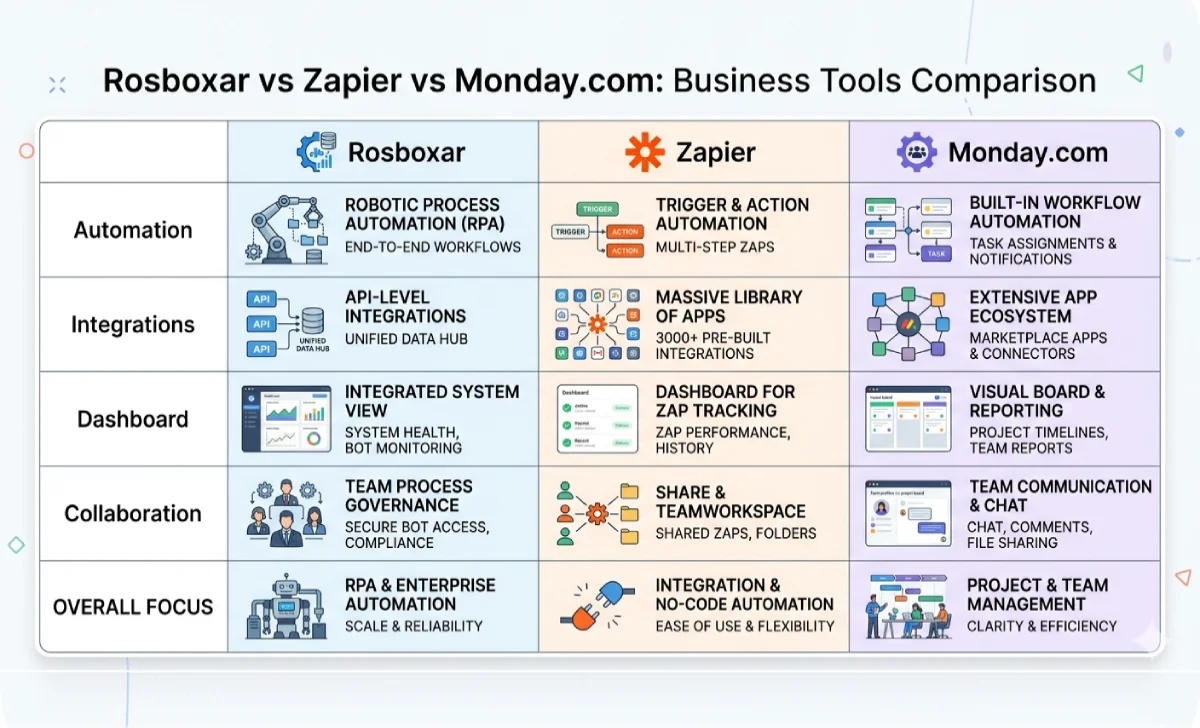
| Feature | Rosboxar | Zapier | Monday.com |
|---|---|---|---|
| Primary use | Business automation + integration hub | Trigger-based automation | Project and task management |
| Integrations | 500+ | 6,000+ | 200+ |
| No-code workflow builder | Yes | Yes | Partial |
| Unified dashboard | Yes | No | Yes |
| Real-time collaboration | Yes | No | Yes |
| AI assistance | Yes | Limited | Limited |
| Enterprise security (SSO, audit) | Yes | Enterprise plan only | Yes |
| Best for | Teams with complex, multi-tool workflows | Simple trigger-action automations | Teams managing projects and tasks |
Zapier leads on raw integration count, but it is built around simple two-step triggers rather than multi-step workflow logic. Monday.com excels at task visibility but does not function as an integration layer. Rosboxar sits between both — more structured than Zapier, more connective than Monday.com.
Is Rosboxar Worth It?
The honest answer depends on where your business is today.
For teams already managing four or more disconnected tools and spending meaningful hours on manual data transfers, Rosboxar’s value is straightforward. Organisations that implement the platform typically report ROI within six to twelve months, primarily through time savings and error reduction — not just headline feature counts.
The 20% productivity loss figure cited by Asana is not abstract: for a team of twenty people, that represents the equivalent output of four full-time employees going nowhere. If even a quarter of that can be recovered through better-connected systems, the math works.
For businesses earlier in their operational maturity — still defining processes, still figuring out which tools to keep — Rosboxar is better held for later. Automating a broken process just makes the broken process faster.
The platform’s modular design means you do not have to commit to everything at once. Start with one integration between two frequently used tools, measure the time saved, and expand from there. That is the approach that tends to stick.