
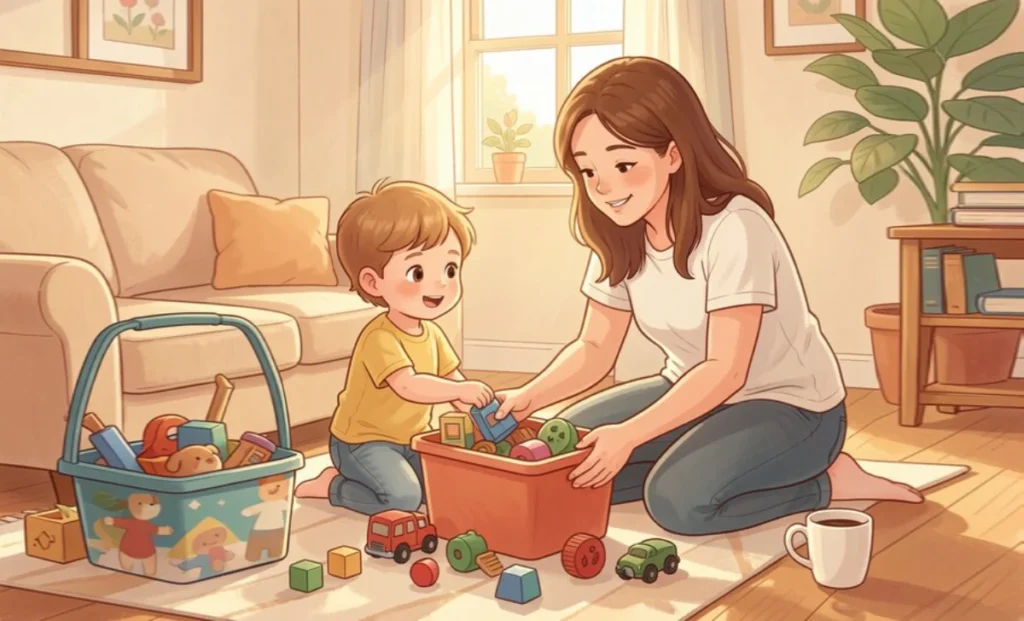
You know the feeling. Toys are scattered across every surface. Someone’s crying about mismatched socks while breakfast burns. The morning routine you planned? Already derailed by 7:15 AM. By evening, you’re too exhausted to remember what you even accomplished.
This isn’t just disorganization. Research shows that household chaos—the ongoing combination of clutter, noise, and unpredictability—affects both parent stress and child development in measurable ways. But here’s what most parenting advice misses: the solution isn’t about becoming more organized or more disciplined. It’s about understanding which changes actually reduce the load on your brain, and starting with the one that matters most for your specific family.
Your Brain on Chaos: Why This Feels Harder Than It Should
Household chaos creates what researchers call cognitive load. Every visible toy, every decision about what’s for dinner, every unexpected tantrum adds to your mental processing demand. Studies examining the relationship between home environment and parenting stress consistently find that visual clutter and unpredictability increase cortisol levels in both parents and children.
This matters because parental stress directly affects your ability to regulate your own emotions, which then influences how you respond to your children. It’s a bidirectional relationship. Chaos increases your stress, which reduces your capacity for patient responses, which can increase child behavioral challenges, which creates more chaos. Understanding this cycle helps explain why you can read all the parenting books and still feel like you’re failing.
The diminished control hypothesis suggests that when parents experience chronic stress, their self-regulation capacity decreases. This isn’t a character flaw. It’s your nervous system responding to environmental demands that exceed your current resources.
Survival Mode vs. Optimization Mode: Start Here First
Before implementing any strategy, you need to identify where your family actually is right now. This distinction changes everything.
Families in survival mode are managing acute stressors like job instability, health crises, major life transitions, or mental health challenges. If you’re in survival mode, your goal isn’t optimization. It’s getting through today safely with everyone fed and reasonably intact.
Families in optimization mode have basic stability and are looking to improve daily functioning. Most parenting advice assumes you’re here, which is why it can feel tone-deaf when you’re not.
If you’re in survival mode, your priorities are safety and meeting basic needs. Decluttering the playroom isn’t the answer. Asking for help, lowering expectations temporarily, and focusing only on red-flag behaviors matter more. This isn’t giving up. It’s appropriate triage.
If you’re in optimization mode, you have bandwidth to experiment with environmental and routine changes. Even here, trying to change everything simultaneously usually backfires.
The One Change That Matters Most: Identifying Your Family’s Biggest Chaos Source
Different families have different primary chaos drivers. Without identifying yours, you’ll waste energy on changes that don’t address your actual problem.
Common chaos sources include:
Morning transitions. If mornings consistently derail your day, this is your target. The issue usually isn’t laziness. It’s decision fatigue, unclear expectations, or developmental mismatches between what your child can manage independently and what you’re asking them to do.
Evening overwhelm. When the dinner-cleanup-bath-bedtime sequence feels impossible, you’re likely dealing with accumulated stress from the day, hunger-driven dysregulation in children, and depletion of everyone’s self-regulation capacity by that time.
Toy and possession overflow. If visual clutter in your main living spaces genuinely prevents you from thinking clearly or constantly triggers arguments about cleanup, this is your primary issue. Research on environmental psychology confirms that visual noise reduces cognitive function and increases stress, particularly for parents.
Behavioral loops. Some families have relatively organized spaces and predictable schedules, but get stuck in repetitive negative interactions. The child refuses, the parent threatens consequences, the child escalates, the parent gets angry. This pattern creates its own chaos regardless of environmental factors.
Inconsistent expectations. When rules change based on parental mood, exhaustion, or which parent is present, children lack the predictability that supports their developing self-regulation. This isn’t about being strict. It’s about being consistent enough that your child knows what to expect.
Identifying your primary chaos source lets you focus limited energy where it will actually make a difference. Trying to fix everything simultaneously usually means fixing nothing effectively.
Why Routines Work (and When They Don’t)
Predictable routines support child self-regulation development because they reduce cognitive demands. When children know what comes next, they don’t need to constantly ask, negotiate, or resist. This frees up their developing executive function for other learning.
Research on family routines and child outcomes shows associations between consistent routines and better behavioral self-regulation, particularly during preschool and early elementary years. The mechanism appears to be that routines provide external structure while a child’s internal regulatory capacity is still developing.
But routines aren’t universally beneficial. Rigid routines can create anxiety in some children, particularly those with inflexible thinking patterns or strong needs for control. The goal is predictable structure, not militaristic scheduling.
Effective routines share these characteristics:
They’re simple. A routine with twelve steps overwhelms everyone. Three to five clear, sequential steps work better.
They’re visual for young children. Pictures showing “brush teeth, put on pajamas, choose a book” support independence better than verbal reminders.
They have flexibility within the structure. The sequence stays the same, but choices exist within it. “We always brush teeth after dinner, but you can choose the toothpaste flavor.”
They match developmental capacity. Expecting a three-year-old to independently complete a morning routine sets everyone up for failure. Age-appropriate expectations matter.
Routines typically take three to six weeks of consistency before they reduce chaos instead of adding to it. During the establishment phase, they require more effort, not less. This is normal.
The Decluttering Decision: What Actually Needs to Go
Decluttering advice often assumes that more minimalism is always better. Research doesn’t support this. The relationship between physical environment and well-being follows a curve, not a straight line. Extremely cluttered environments increase stress, but so can environments that feel sterile or don’t reflect the people living there.
Effective decluttering focuses on reducing visual noise in spaces where you need to think, make decisions, or have calm interactions. This usually means:
Main living areas. Reducing visible toys in shared spaces decreases cognitive load for parents and can improve focused play for children. Toy rotation works well here. Keep out 25-30% of toys, store the rest, and swap monthly.
Kitchen surfaces. Decision fatigue increases throughout the day. Clear counters reduce one source of visual processing demand during already-stressful meal preparation.
Your bedroom. If your bedroom is also a storage overflow, laundry staging area, and home office, it can’t serve its function as a space for rest.
What you likely don’t need to declutter as aggressively:
Children’s bedrooms. Unless the clutter creates safety issues or prevents sleep, children often need their spaces to reflect their interests and feel like theirs.
Sentimental items. The psychological value of objects connected to identity and memory has real importance. The goal isn’t minimalism. It’s reducing chaos.
Items you actually use regularly. If you’re using something weekly, it’s not clutter, even if it’s visible.
The decluttering paradox is that doing it WITH children, though slower, builds skills and respects their attachment to objects. Decluttering FOR children while they’re gone can feel violating and increase anxiety about loss of control.
The Positive Reinforcement Ratio You’re Probably Missing
When household chaos is high, parents typically fall into what family systems researchers call coercive cycles. The child misbehaves, the parent corrects, the child escalates, the parent threatens consequences, the pattern intensifies.
Research on positive-to-negative interaction ratios suggests that relationships require approximately five positive interactions for every negative one to maintain well-being. In chaotic households, this ratio often inverts to multiple negatives per positive.
This happens because misbehavior is impossible to ignore, while expected behavior becomes invisible. Your child sat quietly for twelve minutes? You probably didn’t notice because you were managing the other child’s meltdown.
Shifting this ratio requires intentional attention:
Describe what you see. “You put your shoes by the door.” This acknowledges the behavior without evaluating it.
Catch cooperation immediately. “You came when I called you the first time. That helps us get to the park faster.” This connects the behavior to an outcome the child values.
Reduce correction volume. Not every small infraction needs a comment. Choose your correction moments for safety issues and clear rule violations.
The research on positive reinforcement isn’t suggesting you praise everything or ignore serious problems. It’s recognizing that attention shapes behavior, and if your attention disproportionately focuses on problems, you’ll likely see more problems.
When Your Partner Sees Chaos Differently Than You Do
One frequently overlooked chaos source is parental misalignment. If one parent prioritizes order while the other prioritizes flexibility, if one enforces rules the other ignores, children experience inconsistency that undermines any strategy.
This isn’t about one parent being right. It’s about agreeing on non-negotiable expectations and allowing flexibility on the rest. Commonly, this means:
Agreeing on three to five absolute rules around safety and respect, then enforcing those consistently between both parents. Everything else becomes more flexible based on context and which parent is present.
Having brief weekly check-ins about what’s working and what isn’t. Five minutes of alignment prevents hours of frustration.
Respecting that different parenting styles can coexist if core expectations remain consistent. One parent can be more playful while the other is more structured, as long as bedtime still happens and hitting still gets the same response from both.
Realistic Timelines and What Failure Actually Looks Like
Behavior change research suggests that new habits take anywhere from 18 to 254 days to form, with an average of around 66 days. Parenting changes involve not just your habits but also shifting your children’s expectations and responses.
Expect the first two weeks of any change to feel harder, not easier. You’re adding effort to establish new patterns. If you give up here, you’ll conclude the strategy doesn’t work when you actually stopped before the pattern could be established.
Weeks three through six typically show inconsistent results. Some days feel better, others regress. This isn’t failure. It’s a normal variability in behavior change.
If you’re consistently applying a strategy for eight to ten weeks without any improvement, reassess. Either the strategy doesn’t fit your family’s specific chaos source, or there’s an underlying issue that needs professional support.
Failure looks like a complete return to baseline. Partial improvement counts as success. If mornings are still chaotic but the screaming decreased by half, that’s meaningful progress.
When to Seek Professional Support
Some situations exceed what environmental and routine changes can address. Consider professional support if:
You’ve consistently implemented appropriate strategies for three months without improvement in the specific area you targeted.
Your child’s behavioral challenges affect their functioning at school or in social relationships, not just at home.
You or your partner experiences symptoms of depression, anxiety, or other mental health concerns that limit your capacity to implement strategies.
Your family is experiencing significant transitions like divorce, death, relocation, or job loss that exceed normal stress adaptation.
Your child may have neurodevelopmental differences like ADHD or autism that require specialized approaches.
Family therapy, occupational therapy for sensory or executive function concerns, or individual therapy for parents can provide support that generic advice cannot. This isn’t admitting defeat. It’s recognizing when your family’s needs require specialized expertise.
The Truth About Changing Household Chaos
Small changes can reduce daily chaos, but they require consistency over weeks and months, not days. They work best when matched to your family’s specific chaos source rather than applied generically. And they assume you have baseline stability to build from.
The science behind household chaos effects is clear: environmental unpredictability, visual clutter, and noise affect both parental stress and child self-regulation development. But the solution isn’t perfection. It’s identifying the one or two changes that address your primary chaos source, implementing them consistently, and adjusting based on what actually reduces stress for your specific family.
Some chaos is developmentally normal. Young children are learning to regulate their emotions, manage their bodies, and understand social expectations. This process is inherently messy. The goal isn’t eliminating all chaos. It’s reducing the environmental and interactional patterns that make everything harder than it needs to be.
