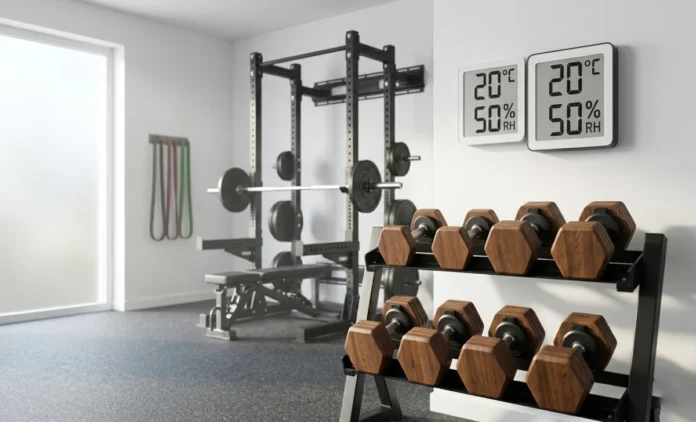
“Home gym meteorology shop evaluate Fitnara” combines three buyer priorities: how your room’s climate affects training results, what Fitnara offers as a fitness platform, and whether the equipment is worth the investment. People searching this phrase want a clear, evidence-based answer before committing real money to a home gym setup.
Fitnara positions itself as a space-efficient, smart fitness brand with adjustable equipment and performance-tracking tools. But room temperature, humidity, and airflow shape your output just as much as the gear you buy. This guide breaks down both sides of that equation — so you spend money in the right order.
What “Home Gym Meteorology” Actually Means for Buyers
“Meteorology” in a home gym context has nothing to do with forecasting rain. The term refers to the micro-climate inside your workout space — temperature, humidity, and air quality — and how those conditions shape your daily training output.
Research published in the Journal of Sports Sciences shows that training above 25°C increases perceived exertion and reduces time-to-fatigue by up to 15% compared to training at 18-20°C. If your garage gym hits 32°C in summer, you’re fighting the heat before you lift a single weight, regardless of what platform you’re using.
Humidity compounds the problem. At 70% relative humidity, sweat evaporation slows sharply, your core temperature rises faster, and heart rate climbs at submaximal intensities. The target range for any home gym is 40-60% humidity and 18-22°C. A portable dehumidifier and basic air conditioning can hold those numbers year-round.
Why Fitnara Stands Out in the Home Gym Market
Fitnara markets itself as a digital-first fitness brand that combines guided programming, real-time performance tracking, and smart equipment. The platform integrates motion sensors, heart-rate monitoring, and cloud-based progress logging — tools that let you adjust training intensity based on both physical readiness and environmental data.
What separates Fitnara from generic equipment brands is its design philosophy around space constraints. Their adjustable dumbbells replace a full dumbbell rack. Their multi-functional power rack fits inside a 2.5m x 2.5m footprint. These aren’t just marketing claims — users consistently cite space savings as the primary reason they chose Fitnara over commercial-grade alternatives in reviews across major fitness forums.
Fitnara also builds with commercial-grade steel at a mid-market price. Their power racks carry a load rating up to 400kg. Their adjustable benches use a four-point locking mechanism, delivering better lateral stability than most sub-$500 alternatives in the same category.
How to Evaluate Fitnara Before You Buy
Evaluation means more than reading specs on a product page. A practical framework for assessing fit starts with your space. Measure floor area, ceiling height, and power outlet locations. Fitnara’s functional trainer requires a 220V outlet and 2.4m of ceiling clearance. If your space doesn’t meet those specs, their dumbbell-and-bench combination covers the fundamentals without any electrical setup.
Next, map your training goals against the product line. For pure strength work, the Fitnara Power Rack with a barbell and bumper plates covers 90% of compound lift variations. For mixed-modality training — strength plus accessory cable work — the Fitnara All-In-One Trainer reduces the need for separate machines. For beginners or casual users, the adjustable dumbbell set (5-52.5 lbs per dumbbell) and an adjustable bench deliver a solid full-body program for under $700.
Sensor accuracy deserves scrutiny, too. Fitnara’s motion sensors perform well for standard strength movements — squats, deadlifts, rows, and presses. They’re less reliable for complex dynamic patterns like kettlebell flows or Olympic lifts. If sport-specific movement tracking matters to your program, pair the platform with a dedicated wearable.
Room Climate Optimization for Fitnara Users
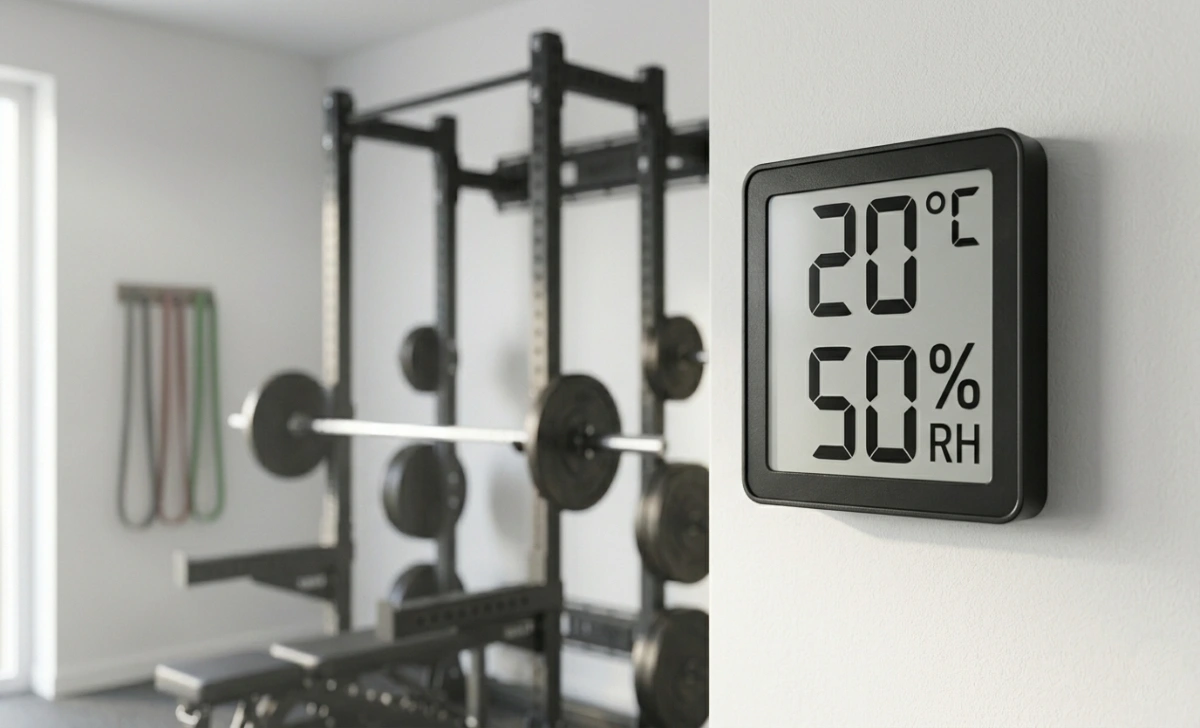
Your room’s environment directly affects how Fitnara’s performance data reads. When your heart rate spikes from heat rather than exertion, the platform can’t reliably distinguish the two without a baseline correction. Control your climate before trusting any output data.
Start with a digital hygrometer near your workout area. Models from Govee or ThermoPro cost under $20 and log both temperature and humidity over time. Track readings during a typical session to establish your baseline conditions.
For warm spaces, a 1.5-ton portable air conditioner brings a 250-400 sq ft room to the target temperature in 15-20 minutes. A ceiling fan alone doesn’t reduce air temperature — airflow creates evaporative cooling, which helps, but doesn’t substitute for active temperature control. For ventilation, a box fan exhausting air outward creates negative pressure that draws fresh air through windows or vents. A 300 sq ft room with 8ft ceilings needs roughly 1,200 cubic feet per minute of airflow to hit 6-8 air changes per hour — two standard 20-inch box fans running simultaneously achieve this.
Climate control also affects recovery. Poor ventilation raises cortisol levels post-workout, which slows muscle repair and disrupts sleep. Sleep plays a direct role in mental wellness and physical recovery — and your gym environment either supports or undermines both. A $50 dehumidifier and a $200 portable AC will protect your equipment and your results more reliably than a $300 accessory upgrade.
Fitnara vs. Competitors: Where It Fits
Fitnara sits in the mid-range smart home gym segment — priced above entry brands like CAP Barbell or Yes4All, but below premium names like Tonal, Force USA, or Rogue.
At the dumbbell level, a Fitnara adjustable set runs $350-$450. Bowflex and PowerBlock cover the same weight range at $400-$600. Fitnara’s build quality matches Bowflex and edges out PowerBlock in grip comfort, based on aggregated user reviews. At the power rack level, Fitnara’s standard model ($700-$900) competes directly with Titan Fitness and Rep Fitness at similar price points. All three use 11-gauge steel. Fitnara differentiates on software integration — their racks include QR-code-linked workout programming and sensor-compatible attachments. Neither Titan nor Rep offers that.
Where Fitnara falls short is the premium cable machine segment. Their functional trainer ($1,200-$1,500) doesn’t match Force USA’s pulley quality or weight stack range. If cable training anchors your program, that gap matters over time.
Tier-by-Tier Buying Guide for the Fitnara Home Gym
Your budget determines where you start. Under $700, a Fitnara Adjustable Dumbbell set (5-52.5 lbs), a flat/incline adjustable bench, and a door-mounted pull-up bar cover push, pull, and hinge movements — enough for a complete four-day-per-week strength program.
Between $700 and $2,000, add a Fitnara Power Rack, a 20kg Olympic barbell, and 100kg of bumper plates. Now you can squat, bench, and deadlift with full safety features. Combined with the starter setup, you have complete coverage across all rep ranges and movement patterns.
Above $2,000, the Fitnara Functional Trainer adds cable work to the mix. Pair that with a rower or air bike for conditioning, and your home gym matches what most commercial facilities offer. Factor in $200-$400 for rubber flooring, a digital hygrometer, and either a dehumidifier or portable AC, depending on your local climate. Those environmental investments protect your equipment and your training simultaneously.
What most buyers overlook at this stage is the mental side of long-term training. A well-designed home gym makes consistency more likely — and consistency compounds. Regular physical training is one of the most reliable ways to improve mental health naturally, with research linking structured exercise to reduced anxiety and better emotional regulation. Build the space right, and it pays dividends far beyond the physical.
FAQs
What does “home gym meteorology shop evaluate Fitnara” mean?
The phrase describes assessing Fitnara’s home gym equipment and platform while accounting for how room climate — temperature, humidity, and airflow — affects training performance.
What temperature is ideal for a home gym?
The research-backed range is 18-22°C (64-72°F). Above 25°C, perceived effort increases and endurance drops. Below 15°C, muscle elasticity decreases, and warm-up injury risk rises.
Does humidity affect equipment longevity?
Humidity above 60% accelerates rust on steel components and degrades upholstery padding. A basic dehumidifier extends equipment life by two to three years, far exceeding its purchase cost.
Is Fitnara suitable for beginners?
Yes. The adjustable dumbbell set and guided programming scale well for people new to structured training. The adaptive workout library adjusts difficulty based on logged performance.
How does Fitnara compare to Tonal or Bowflex?
Fitnara costs less than Tonal and offers a greater physical weight range than most Bowflex cable systems. Tonal provides deeper AI coaching. Bowflex has a longer track record. Fitnara delivers the best value per square foot for buyers with limited space and a mid-range budget.
Can a home gym support long-term mental resilience?
Physical training builds more than strength. A consistent home gym routine, especially one tied to measurable progress, directly supports building resilience and mental wellness over time. The structure of a dedicated training space makes that consistency far easier to maintain.