AI search accuracy in 2025 varies by platform and query type. Systems like Google AI Overviews, Perplexity, and Bing Copilot perform well on stable factual topics but remain unreliable for current events, medical information, and niche questions. Hallucination — where AI generates false but confident answers — is still an unsolved problem across all major platforms.
You ask an AI search engine a factual question. It answers instantly, confidently, and in plain English. But is it right?
That question matters more now than it did a year ago. AI-generated answers have moved from an experimental feature to the default experience on Google, Bing, and Perplexity. Millions of people are acting on these answers — in healthcare decisions, financial research, and everyday problem-solving — often without checking whether the information is accurate.
This article breaks down where AI search accuracy stands in 2025, what causes errors, which platforms perform better, and what you should do differently based on that.
What “AI Search Accuracy” Actually Means
Accuracy in AI search isn’t one metric — it’s several, and they don’t always move together.
- Factual accuracy: Did the AI state something true?
- Source quality: Did it pull that answer from a credible, current source?
- Relevance: Did it answer the question you actually asked, not a simpler version of it?
- Hallucination rate: How often does it invent information that sounds correct but isn’t?
Most accuracy discussions focus on the first point and ignore the last. That’s a mistake. Hallucination — where an AI model generates plausible-sounding but false information — is the single biggest accuracy problem in AI search, and it’s still not solved.
Where AI Search Was, and Where It Is Now
Early search engines matched keywords to pages. They had no understanding of meaning — just pattern matching. The shift to AI-powered search changed that fundamentally.
The turning point came with large language models (LLMs) combined with Retrieval-Augmented Generation (RAG). Instead of generating answers purely from training data, RAG-based systems retrieve relevant documents first, then generate a response grounded in that content. This reduces hallucination significantly compared to purely generative systems.
Google’s AI Overviews (launched in 2024), Perplexity AI, and Bing Copilot all use variations of this approach. The accuracy gap between them comes down to how well they implement retrieval — which sources they index, how they rank source credibility, and how they handle queries where no reliable source exists.
How Accurate Are AI Search Results in 2025?
Published research on AI search accuracy is still limited, partly because these systems change frequently and partly because measuring accuracy at scale is methodologically hard.
What we do know from independent testing and available research:
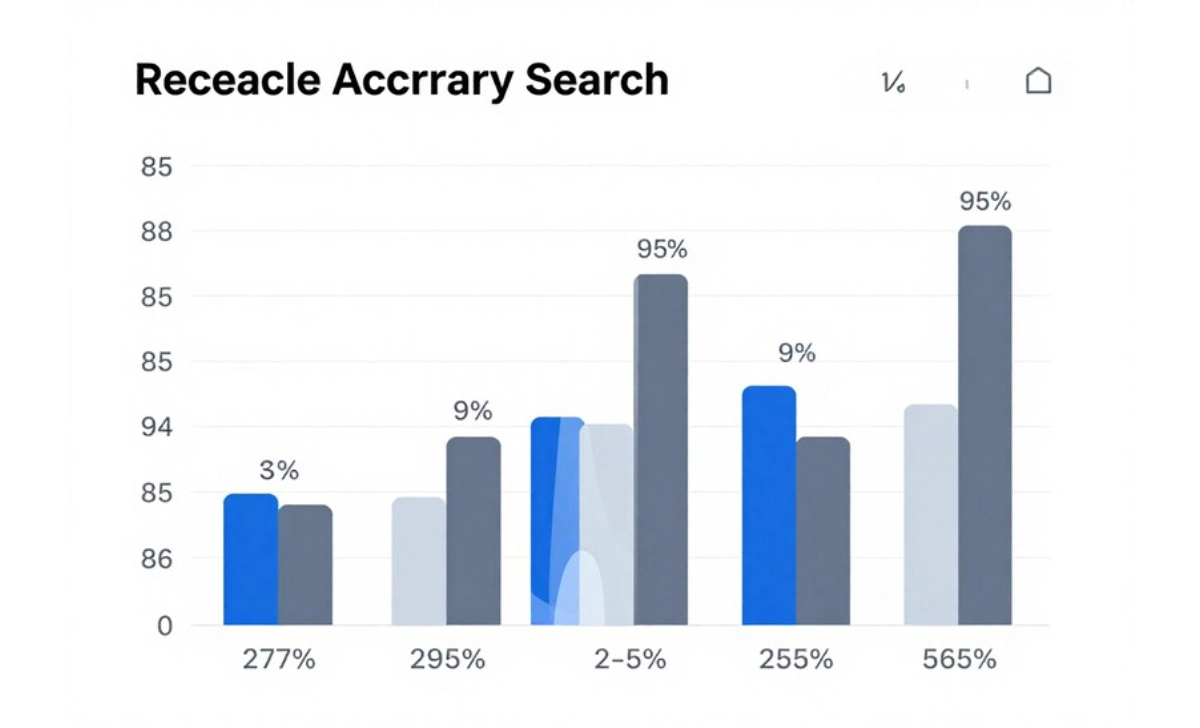
- Perplexity AI has been tested by multiple tech journalists and researchers for factual accuracy on verifiable questions. Results vary significantly by query type — it performs well on stable factual topics and worse on recent events or niche subjects.
- Google AI Overviews drew criticism after launch for surfacing inaccurate information on medical and safety topics. Google has since applied filtering to reduce these errors on high-stakes queries, but accuracy on edge-case questions remains inconsistent.
- Bing Copilot, built on GPT-4, tends to be more conservative — it more often declines to answer when uncertain, which reduces confident wrong answers but also limits usefulness on some queries.
The consistent finding across independent evaluations: AI search performs best on popular, well-documented topics and worst on recent events, contested claims, and niche technical questions.
The Hallucination Problem
Hallucination is what happens when an AI generates information that isn’t in any source — it just makes it up, presented with the same confidence as accurate information.
This isn’t a bug that gets patched and disappears. It’s a structural feature of how large language models work. They predict what words should come next based on patterns — and sometimes those patterns lead to plausible but false outputs.
For AI search specifically, RAG architectures reduce hallucination by grounding answers in retrieved documents. But they don’t eliminate it, for several reasons:
- The retrieved document may itself be wrong
- The model may misread or misquote the document
- On queries where no good source exists, the model may still generate an answer rather than saying “I don’t know.”
The practical implication: for any AI search answer you plan to act on, check the cited source directly. Don’t assume the citation validates the claim — verify that the source actually says what the AI says it says.
How Natural Language Processing Shapes Search Accuracy
Natural Language Processing (NLP) is what lets search engines understand what you meant, not just what you typed. This matters for accuracy because the same intent can be expressed in dozens of different ways.
Modern NLP handles:
- Synonyms and paraphrasing: “heart attack symptoms” and “signs of myocardial infarction” should return the same results
- Conversational queries: Questions phrased naturally (“what should I eat if I have gout”) rather than as keyword strings
- Ambiguous queries: When “apple” means the company vs. the fruit — context resolves it
- Multi-step questions: Queries that require understanding a chain of logic, not just matching keywords
Where NLP still falls short is in queries that require real-world common sense, cultural context, or very recent knowledge that wasn’t in the training data.
Industry-Specific Accuracy: Where AI Search Gets It Right and Wrong
Accuracy isn’t uniform across topics. The industry context changes everything.
Healthcare:e This is the highest-risk area. AI search on medical topics can surface outdated treatment guidelines, misattribute drug interactions, or present contested research as settled fact. Google has applied additional filters here, but independent evaluations still find errors on specific medical queries. The rule: AI search can help you understand a condition, but it is not a substitute for current clinical guidance.
Finance AI search on financial topics — tax rules, investment regulations, market data — is unreliable for time-sensitive information. Tax law changes frequently, and AI training data lags real-world updates. Use AI search for general concepts; go to primary sources (IRS, SEC, central bank sites) for current rules.
E-commerce and Product Research.h This is where AI search performs relatively well. Product descriptions, feature comparisons, and review summaries are well-documented online and change slowly enough that AI answers tend to be accurate. The risk here is outdated pricing or discontinued products.
Current Eve:nts This is the weakest area. AI search systems have knowledge cutoffs and uneven access to live web data. On breaking or fast-moving stories, errors are common. Use primary news sources directly.
What Makes One Platform More Accurate Than Another
The accuracy differences between Google AI Overviews, Perplexity, and Bing Copilot come down to four factors:
- Source index quality — What sites does the system retrieve from? A search engine that retrieves from authoritative sources will produce more accurate answers than one that indexes low-quality content.
- Retrieval precision — Can the system find the specific document passage that answers the query, not just a page on the same topic?
- Model calibration — Does the system say “I’m not sure” when it should? An overconfident model that always answers is more dangerous than one that declines on uncertain queries.
- Update frequency — How often is the system’s knowledge updated? For time-sensitive topics, this matters significantly.
No platform is consistently dominant across all four. Your choice of tool should match the type of query you’re making.
How to Use AI Search Without Getting Burned
Given where accuracy stands today, here’s a practical framework:
- For stable factual topics (history, science fundamentals, geography): AI search is generally reliable. Still worth a spot-check on anything you’ll repeat to others.
- For current events or recent data: Go to primary sources. AI search is a starting point, not the answer.
- For medical, legal, or financial decisions: AI search can help you understand the landscape and form better questions. Never use it as the final authority.
- For any answer you plan to cite or act on: Click through to the source. Check that the source actually supports the claim.
The most dangerous use of AI search is treating a confident answer as a verified one.

Where AI Search Is Heading
The near-term trajectory is clear: AI search will become more accurate as retrieval improves, source quality filtering gets better, and models get better at recognizing uncertainty.
The less certain question is whether users will develop appropriate skepticism to match. Systems that are right 90% of the time train users to trust them — which makes the 10% more dangerous, not less.
The most important development to watch isn’t accuracy improvement in absolute terms. It’s whether AI search systems become better at communicating their own confidence level — flagging when they’re drawing on strong, recent sources vs. when they’re extrapolating.
Until that’s solved, the human verification step isn’t optional. It’s the entire safety layer.
Conclusion
AI search accuracy in 2025 is real and measurable progress — not marketing. Retrieval-augmented systems have meaningfully reduced hallucination compared to earlier generative AI, and NLP improvements have made AI search genuinely useful for millions of daily queries.
But the accuracy is uneven. It varies by platform, by topic, by query type, and by how recently the underlying information changed. The gap between “usually right” and “reliably right” is still wide enough to matter.
Use AI search for what it’s actually good at. Verify anything important. And treat a confident AI answer the same way you’d treat a confident answer from a smart person who hasn’t checked their sources — worth considering, not worth assuming.