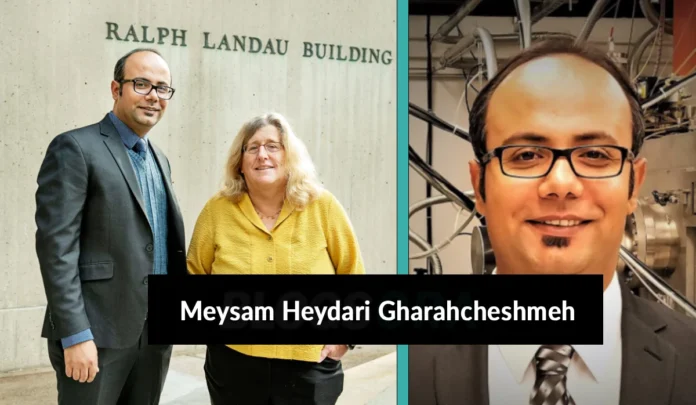
When a polymer scientist achieves a world-record electrical conductivity figure, the materials engineering community takes notice. That is exactly what happened with Dr Meysam Heydari Gharahcheshmeh — an Iranian-born researcher who went from engineering studies in Iran to a postdoctoral fellowship at MIT and, eventually, to leading his own laboratory at one of California’s major public universities.
His story is not built on headlines or social media fame. It is built on peer-reviewed publications, citation counts, and breakthroughs that influence how engineers think about next-generation energy devices and flexible electronics. If you are searching for verified facts about his background, career, and academic contributions, this profile covers everything currently on the public record.
Early Life and Academic Background
Meysam Heydari Gharahcheshmeh (میثم حیدری قرهچشمه) is an Iranian-born scientist and engineer who developed an early interest in materials and their structural behaviour during his academic beginnings in Iran.
The precise details of his early schooling and undergraduate institution have not been published in public-facing sources, which is common for researchers who gain recognition through graduate and postdoctoral work rather than through public profiles. What is documented, however, is a clear and consistent upward trajectory through some of North America’s most respected engineering institutions.
Education
Ph.D. — University of Houston (2017)
Dr Meysam Heydari Gharahcheshmeh earned his PhD in Materials Science and Engineering from the University of Houston in 2017. The University of Houston has a well-regarded materials engineering program, and his doctoral work laid the foundation for the thin-film and polymer research that would define his career.
Materials Science and Engineering is a field that sits at the crossroads of chemistry, physics, and mechanical engineering. Researchers in this area study how the internal structure of a material — down to the atomic level — determines how it behaves under real-world conditions. Dr Heydari Gharahcheshmeh’s doctoral training focused on exactly this kind of structural thinking, which became central to every research project that followed.
Career Timeline
Postdoctoral Associate — MIT (2017–2021)
Following his doctorate, Heydari Gharahcheshmeh joined the Massachusetts Institute of Technology (MIT) as a postdoctoral associate in the Department of Chemical Engineering, where he worked under Professor Karen K. Gleason between 2017 and 2021.
This was not a minor appointment. Professor Karen K. Gleason is one of the world’s leading authorities on chemical vapour deposition — a manufacturing process that deposits thin films of material onto a surface using chemical reactions in gas form. Working in her lab gave Dr Heydari Gharahcheshmeh access to both world-class equipment and one of the most respected mentorships available in the field.
At MIT, his work focused on nanostructural engineering of conducting and semiconducting polymers fabricated using oxidative chemical vapour deposition (oCVD) and initiated CVD (iCVD) techniques, targeting energy device applications and biocompatible wearable electronics.
The four years at MIT produced the most widely cited work of his career.
Assistant Professor — University of Mississippi (2021–2022)
Before his current position at SDSU, Dr Heydari Gharahcheshmeh was an Assistant Professor in the Department of Mechanical Engineering at the University of Mississippi from 2021 to 2022. This role marked his transition from researcher to academic, where he began managing students, teaching courses, and building independent research programs.
Assistant Professor — San Diego State University (2022–Present)
He is currently an Assistant Professor in the Department of Mechanical Engineering at San Diego State University (SDSU), where his research focuses on the texture and nanostructural engineering of advanced functional materials and high-performance conductors for energy and biocompatible device applications.
At SDSU, Heydari Gharahcheshmeh founded the Advanced Manufacturing for Energy Devices (AMED) Lab, where he currently serves as director. The lab focuses on developing advanced functional materials for modern technological challenges, including renewable energy systems, flexible electronics, and biocompatible devices.
Research Focus and Areas of Expertise
Dr Heydari Gharahcheshmeh’s research sits in a space most people never encounter directly — yet it affects technologies they use every day, from flexible phone screens to wearable health monitors.
His areas of expertise include advanced manufacturing, chemical vapour deposition methods, texture and nanostructural engineering, energy harvesting and storage materials, and polymer thin film deposition.
The AMED Lab at SDSU currently studies conducting and semiconducting polymers as well as superconductors, manufactured using methods such as oxidative chemical vapour deposition (oCVD), initiated chemical vapour deposition (iCVD), and metal-organic chemical vapour deposition (MOCVD). The lab’s core scientific focus includes texture and nanostructure engineering of advanced organic and inorganic conductors, as well as materials fabrication development based on advanced CVD techniques.
To put this plainly: his lab works on making electrically conductive materials perform better, using precise manufacturing methods that control the material’s structure at the nanoscale, which is roughly ten thousand times thinner than a human hair.
Key Research Breakthrough: World-Record Electrical Conductivity
The achievement that put Dr Heydari Gharahcheshmeh on the international research map came out of his MIT postdoc years.
Working alongside Professor Karen K. Gleason and collaborators, the team achieved a record high electrical conductivity of 7,520 S/cm in PEDOT thin films grown by water-assisted oxidative chemical vapour deposition.
PEDOT (poly(3,4-ethylenedioxythiophene)) is a conducting polymer widely used in flexible electronics and solar cells. Making it conduct electricity more efficiently — while keeping it lightweight, flexible, and processable — has been a major challenge in materials research for years.
The method developed advances the properties of flexible transparent conductors desired for next-generation lightweight and wearable electronic devices, as published in Science Advances (2019).
A paper in Science Advances — an open-access journal from the publishers of Science — carries significant weight in the scientific community. The fact that this work has been widely cited since publication reflects its impact on how the broader research community approaches polymer conductors.
As of current records, Dr Heydari Gharahcheshmeh’s published work has been cited over 2,337 times on Google Scholar, a strong indicator of influence within the materials science and engineering field.
Published Work and Academic Contributions
Beyond the headline PEDOT conductivity paper, Dr Heydari Gharahcheshmeh has contributed to research across several connected topics.
He authored a chapter titled “Manufacturing of Conducting and Semiconducting Polymers by Chemical Vapour Deposition (CVD) Method,” published by IntechOpen. The chapter covers CVD as a technique for fabricating high-quality thin films, including the use of conducting polymers in next-generation electronic, optoelectronic, and energy storage devices.
His published research covers conducting polymer fabrication, humidity-initiated gas sensing, advanced CVD manufacturing methods, and thin film applications in energy conversion and wearable devices. Each of these topics connects to practical engineering problems in renewable energy, medical electronics, and sustainable manufacturing.
Professionals who build lasting credibility through consistently published output — rather than media coverage — often require this kind of detailed career documentation to be properly understood. Michelle Garcia Winner, an educator and researcher recognised for her body of published academic work, is a comparable example of someone whose public profile is built almost entirely on professional contributions rather than personal visibility.
Net Worth
There is no publicly available financial data for Dr Meysam Heydari Gharahcheshmeh. He is an academic scientist, not a public-company executive or celebrity, and personal income figures for university faculty are not typically disclosed unless institutional salary databases are public.
This pattern is not unique to academics. Profiles of figures such as Charles Anthony Vandross illustrate the same dynamic — biographical facts can be well documented while financial specifics remain absent from the public record entirely. The two are separate categories of information, and the absence of one does not reflect on the accuracy of the other.
What is known is that Dr Heydari Gharahcheshmeh holds an Assistant Professor position at a major U.S. public research university, leads a funded research laboratory, and has an active publication record — all markers of a stable and respected academic career. Anyone claiming specific net worth figures for him online is speculating without a factual basis.
Personal Life
Dr Heydari Gharahcheshmeh’s personal life — including details about family or location outside of his professional affiliations — has not been made public in any verified source. This is a boundary many professionals choose to maintain deliberately, keeping their private lives separate from their searchable public identity. Henry Olyphant is a notable example of someone who has similarly kept personal matters out of the public record while still maintaining a clear and documented professional presence. Dr Heydari Gharahcheshmeh follows the same approach — his identity in any public-facing context is defined by his research, his institutional roles, and his academic output.
His professional base is the Department of Mechanical Engineering at San Diego State University, located at 5500 Campanile Drive, San Diego, California. He maintains a personal academic website and a research group site at SDSU, both of which provide updated information on his ongoing projects and publications.
Why His Work Matters
The materials Dr Heydari Gharahcheshmeh works with are not obscure laboratory curiosities. They are the building blocks for technologies the world is actively building toward.
Flexible electronics — thin, bendable screens and sensors — require materials that can conduct electricity without the brittleness of traditional metals. Wearable medical devices that monitor health in real time need materials compatible with human skin. Renewable energy systems need better, lighter, and more efficient conductor materials to make solar cells and batteries more practical at scale.
Every research project in the AMED Lab connects to at least one of these problems. The combination of experimental chemistry, computational modelling, and CVD manufacturing expertise in a single lab is relatively uncommon — and it is what makes his group’s work applicable across multiple industries rather than being limited to a single application.
Career at a Glance
| Year | Role | Institution |
|---|---|---|
| Pre-2017 | Ph.D. Student | University of Houston |
| 2017 | Ph.D. Awarded | University of Houston |
| 2017–2021 | Postdoctoral Associate | MIT (Chemical Engineering) |
| 2021–2022 | Assistant Professor | University of Mississippi |
| 2022–Present | Assistant Professor + AMED Lab Director | San Diego State University |
Conclusion
Dr Meysam Heydari Gharahcheshmeh is a credentialed and productive materials scientist whose career path — from Iran to Houston to MIT to a California faculty position — reflects a level of academic persistence that tends to produce real results. His work on conducting polymers, particularly the record-setting PEDOT conductivity achievement, has left a measurable mark on the field, as evidenced by his citation count and continued institutional support.
He is not a business mogul or media figure. He is a working scientist whose influence is measured in publications, citations, and the researchers his lab trains. For anyone researching his background — whether for academic, journalistic, or professional purposes — the facts above represent everything currently verifiable from public sources.
FAQs
Who is Meysam Heydari Gharahcheshmeh?
He is an Iranian-born materials scientist and engineer, currently an Assistant Professor of Mechanical Engineering at San Diego State University (SDSU). He earned his PhD at the University of Houston and completed a postdoctoral fellowship at MIT.
Where does Meysam Heydari Gharahcheshmeh work?
He works in the Department of Mechanical Engineering at San Diego State University, where he also directs the Advanced Manufacturing for Energy Devices (AMED) Lab.
What is Meysam Heydari Gharahcheshmeh known for?
He is known primarily for his work in nanostructural engineering of conducting polymers and for co-producing a world-record electrical conductivity result of 7,520 S/cm in PEDOT polymer films — published in Science Advances in 2019.
What does Meysam Heydari Gharahcheshmeh research?
His research covers texture and nanostructural engineering of advanced functional materials, chemical vapour deposition manufacturing, conducting polymers, superconductors, and materials for energy devices and wearable electronics.
What is Meysam Heydari Gharahcheshmeh’s educational background?
He completed a PhD in Materials Science and Engineering at the University of Houston (2017) and postdoctoral training in Chemical Engineering at MIT (2017–2021).
Is there a net worth figure for Meysam Heydari Gharahcheshmeh?
No verified net worth figure exists. He is an academic scientist, and personal financial data for university faculty is not a matter of public record unless disclosed through inst